
A remarkable group of healthcare executives gathered for Leading AI-Powered Transformation in Healthcare, a Catalyst Constellations roundtable designed to cut through the hype and get real about what it takes to make AI work in complex organizations.
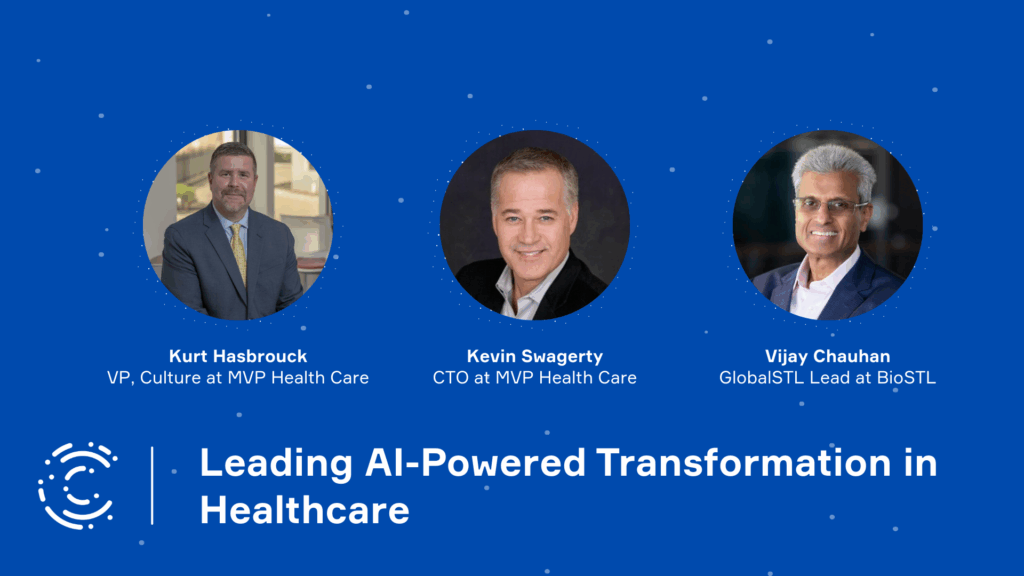
Our Guest Speakers Set the Stage
Vijay Chauhan, GlobalSTL Lead at BioSTL, opened with a clear signal: nearly 70% of leaders say cultural, not technical, barriers are the biggest challenge to AI adoption.
Kevin Swagerty, Chief Technology Officer, and Kurt Hasbrouck, Vice President, Culture, at MVP Health Care, shared how they’re putting people, not platforms, at the center of their strategy.
- They spotlighted a Digital Twin project born from empowering internal change agents to explore real problems and design solutions.
- The big unlock: a clear way to source, vet, and prioritize AI use cases based on value, cost, and complexity, anchored in strategic alignment and executive sponsorship.
Then we opened it up for a full group discussion.
A Shared Reframe Emerged
As the conversation progressed, a shared insight emerged: the focus is not on “AI” itself but on solving meaningful organizational problems. Participants reflected on previous technology shifts: desktop computing, email, mobile, and recognized that while AI introduces new speed and scale, the underlying patterns of organizational change are familiar.
Cultural Barriers Leaders Are Grappling With
Participants surfaced several common barriers shaping AI adoption across the sector:
- Employee fears, including job loss, failure, and over-reliance on AI
- Misalignment between new tools and actual organizational needs
- Balancing top-down direction with bottom-up innovation
- Lack of executive sponsorship and alignment
- Cost-to-value concerns
Strategies Leaders Are Using to Break Through
Leaders shared concrete practices that are already advancing adoption and impact:
- Focus AI initiatives on solving employee-relevant problems with measurable impact.
- Align investments with enterprise strategy and secure visible executive sponsorship.
- Take time to understand and address fears directly and transparently. One participant offered: “FEAR = False Evidence Appearing Real.”
- Model desired behaviors, particularly among middle managers, who are essential in operationalizing change.
- Create experiential learning opportunities through AI Labs, live use-case demonstrations, and collaborative solutioning.
- Use disciplined metrics and 30-60-90-day checkpoints to rapidly evaluate initiatives and discontinue low-impact efforts.
- Pair innovation with strong governance to build trust and confidence.
This was a lively, solution-oriented conversation that reflected both the urgency and the opportunity of this moment. If you missed it, you’ll want to be in the room for the next one.