
Month: July 2025
The Catalysts Guide to Leading Change with Tracey Lovejoy and Shannon Lucas
In this episode of Change Leader Insights, Jessica Crow speaks with Catalyst Constellations co-founders, Tracey Lovejoy and Shannon Lucas, about what it means to be a change Catalyst, why these individuals are often misunderstood in the workplace, and how Catalysts can leverage their strengths to help organizations successfully innovate and change, without burning out in the process.
Listen to the full episode here.

The power of clarity of vision
A few months ago, John Morley would tell you that he had a “smorgasbord of ideas” regarding his career. But two weeks ago, he got every catalysts’ dream job. John used the power of clarity of vision to get where we wanted to go.
His job description is literally to change an organization—John is a Business Design Strategist at Hitachi Vantara (a subsidiary of Hitachi). He works alongside the CTO, to “catalyze” the organization—to move forward with its digital transformation agenda, and to explore new things.
How exactly did he get there?
Identifying as a Catalyst
John says his journey began when we met, and he understood the value of his specific skill-set: to see the big picture and identify where he can make logical and likely connections. In an approachable and slightly Irish accent John says he’s, “sort of a wheeler and dealer… I listen to people, find out what they’re working on, and I say ‘ooh, there’s someone over there that you should go talk to’.” You can hear the excitement in John’s voice as he talks about organizational transformation and getting others on board. We call people like John, catalysts.
Clarity of Vision
Earlier this year, John experienced an important mindset shift at the Catalyst Constellations Retreat. He identified his personal mission and vision, and was able to prioritize his next steps based on this mission. John said that the retreat’s funnel structure helped him narrow his broad vision into specific next steps.
Rejuvenation & Connection
The retreat was a “significant accelerator” for John. Clarity was part of it, but so were restoration, and connection to others like him. In our interview, John describes how a long walk by the beach and a “catalytic” meditation taught him how taking breaks can lead to personal empowerment. And how meaningful it was to feel part of a greater whole, like at a BBQ under the stars when a fellow catalyst came up to him and said, “I love your energy.” This was one of many moments that enabled him to embrace his vulnerability and get in touch with his needs to be a more effective change agent. “I keep using the word catalyze, but that’s really how I think about it, so there you go,” he says.
Catalyzing Your Personal Journey
Shortly after the retreat, John met up with a former colleague who now works at Hitachi. “He asked me come work with him and do what it is I do”, says John with a warm smile. “That was a great personal moment for me, because that came directly from the retreat”.

The Smallest Investment… In Yourself
We need to talk about the smallest investment in yourself. Because so many people struggle with too much work. From burnout.
People who identify as change agents are often doing their catalytic work, in addition to their day job, which can increase the feeling of burnout.
Making the investment
One of my favorite TedTalks by Nigel Marsh speaks to the issue of finding ways to sustain ourselves and make time for the things that are most important in our lives.
“Being more balanced doesn’t mean dramatic upheaval in your life. With the smallest investment in the right places, you can radically transform the quality of your relationships and the quality of your life. Moreover, I think, it can transform society.”
This is a big part of the reason why we created Catalyst Constellation. And specifically Catalyst Constellations’ retreats.
Retreats are designed with rejuvenation in mind; a beautiful setting, great food, mediation, yoga, hikes. It’s the gift of a few days for change agents to come together with a tribe who understand the specific energetic challenges of catalytic work.
Together we (re)commit to rejuvenation practices (small and large) to help sustain ourselves and our work. Participants leave with an ongoing peer group to support each other on the journey of finding “balance” and continually committing to investing our time in the right places.
The retreat also focuses on clarifying your vision and creating an action map. You don’t just leave rejuvenated; you have a concrete path forward to focus your renewed energy. The cohort co-creates and refines each individuals’ plan; leveraging the wisdom of the group to accelerate your progress after the retreat.
As change agents we need to sustain ourselves because the work we are catalyzing is important. We’re creating positive, lasting change in the world. We invite you to connect with us to find out more about this amazing opportunity to invest in yourself and your work.
The Catalyst’s Guide to Creating Positive Change
I recently interviewed Shannon Lucas, Co-Founder & Co-CEO at Catalyst Constellations and best-selling author, regarding her new book (co-authored with Tracey Lovejoy) and the research leading up to it regarding a unique type of changemaker known as a Catalyst. Read on to find out if you are (or are managing) a Catalyst to gain a better understanding of a Catalyst’s particular needs, traits, and talents, and be sure to take the assessment and download the ebook and tools to learn more.
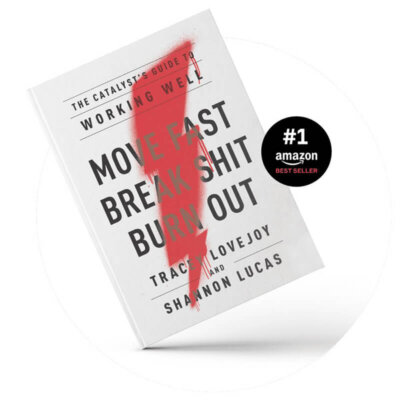
MR: Shannon, welcome, and congratulations on the success of your new book, Move Fast. Break Shit. Burn Out. How did you and your co-author, Tracey Lovejoy, decide to write a book focusing on the needs of Catalysts?
Shannon: Thank you! We wrote the book we wished we’d had earlier in our careers.
Being Catalysts ourselves, we struggled more than we needed to for much of our lives because of a lack of understanding of the fact that we operate in unique ways. We didn’t have the frameworks to understand or contextualize how we showed up differently from our co-workers (or even our partners!). We didn’t have a language to describe it.
I spent years searching for descriptors that provided an understanding of how I operate—trying on identities like “innovator,” “entrepreneur,” and “intrapreneur.” But being a Catalyst is more than a job title or organizational context. It’s how we show up in the world.
When Tracey did the foundational research on Catalysts, the insights from the data were game-changing for both of us personally. We wanted to share those insights with the world.
We’re a mission-driven company creating a global Catalyst movement. In our dream world, Catalysts are connected to one another and understand and honor their unique qualities, which amplifies the creation of bolder and more powerful change in the world.
In order for this to happen, Catalysts must first be able to self-identify. So we created the Catalyst personal operating manual as a starting point. It creates a shared language and frame of reference for Catalysts around the world—the essential foundations for a global movement.
There is a lot of literature about change management, innovation, entrepreneurship, but not a lot out there about the changemakers themselves. Further, there’s not enough literature about how to support the unique innate change makers who will literally (unintentionally) sacrifice their well-being to drive change in the world. And of course, a burnt-out Catalyst creates no change at all.
We need fired-up positive changemakers now more than ever. The survival of the planet depends on it.
MR: Many people probably want to think of themselves as doers who make some type of impact. But how do you know if you’re a Catalyst? What are the tell-tale signs? What does it mean to be a Catalyst?
Shannon: Catalysts aren’t your typical changemakers. They’re innovators who can’t stop taking in information, connecting dots, and changing the world—even when the world hasn’t asked for it.
Catalysts are the ones who thrive on discussions around change, even when they realize they can’t manifest them all. They’re the ones who see possibility as a form of play, rather than getting annoyed or overwhelmed. And they’re the ones who burn out from moving at the speed of light. If that sounds familiar, you aren’t broken, difficult, or an incurable workaholic. You’re a Catalyst.
It’s an innate way of being, it’s not a choice. Though sometimes we wish we had a choice.
At a high level, Catalysts have six attributes. Let’s take them one by one.
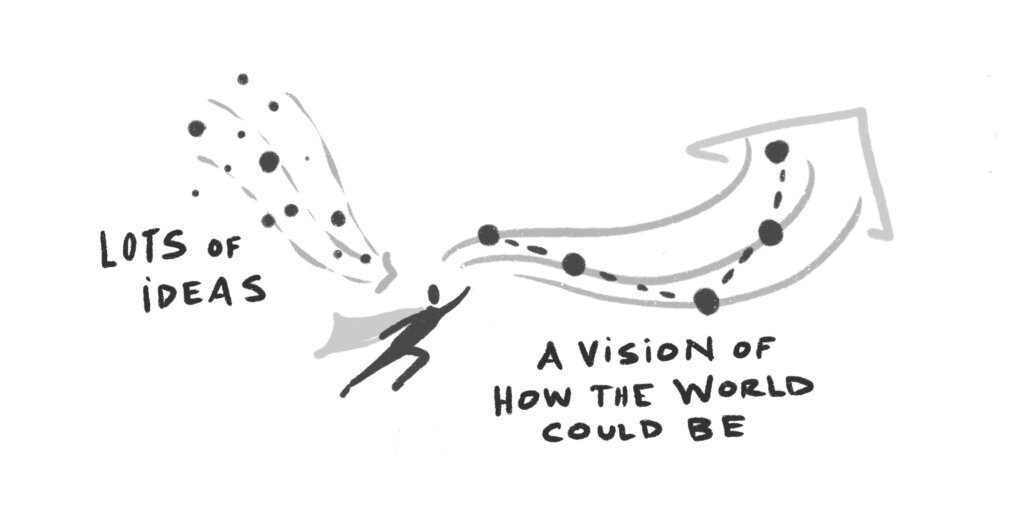
First of all, we piece together information quickly. We synthesize data from a variety of sources on an almost visceral or ethereal level. We connect dots from conversations, business articles, sci-fi books, customer feedback, movies, and more.
From that, we see many ideas and see lots of possibilities. From all of that synthesizing, we start to see myriad possibilities of the way things could improve, from projects at work to standing in line at Starbucks.
We create visions, distilling down all the possibilities we saw into concrete visions for how our project, team, system, or family could be improved.
If we stopped there, we might just be called visionaries.
But we have a deep drive for ACTION that transforms. We have a relentless, almost physical need to see that vision manifested in the world. We move fast into action to make it a reality.
As Catalysts, we move through the world with an experimentation mindset. Because we are often creating net-new solutions, there often isn’t a tried-and-true way of achieving our vision. We are comfortable trying new approaches to create change. In fact, if we’re too familiar with a process, we’re likely to get bored.
The final attribute of being a Catalyst is less about how we feel and more about how people describe us. We are often told that we are intuitive and perceived as comfortable with risk and ambiguity. This is more how people describe us than how we might actually feel. We have all the data from step 1, so it actually feels like common sense to us by the time we start moving into action. We can’t always explain the dot-connecting in a clear enough way for people to understand, so it can be perceived as intuition (which also can be part of our process).
It’s important to us that people own the term Catalyst. While we have a lot of data that we can leverage to help companies identify their Catalysts, we’re not out to put unwanted labels on people or keep people out of the community.
If you’re curious about whether or not you’re a Catalyst, you can take our Catalyst quiz. But if it already sounds like you and you love the term, welcome to the global community!
MR: In your consulting practice, you help organizations identify Catalyst employees, nurture their exceptional skill set, and advise on internal change and transformation projects that accelerate change, increase success, and retain high-potential employees. What are the unique needs of Catalysts that managers and leaders need to understand and nurture?
Shannon: This is the time of the Catalyst.
Last year removed any doubt that we live in a Volatile, Uncertain, Complex, and Ambiguous (VUCA) world. And Catalysts are essentially born VUCA-ready. This is why so many companies are excited to find these action-oriented problem-solvers.
We recently released an eBook, The Catalyst Innovator’s Guide to Thriving in an Uncertain World, which speaks to the C-Suite about the impact that Catalysts can have helping their organization navigate our VUCA reality. We captured key lessons from C-Levels about what it takes to enable a Catalyst-friendly environment, which in turn helped these companies thrive during the pandemic.
The good news: the things that are essential for Catalysts to be successful are good for everyone. Google’s Project Aristotle looked at the attributes of high-performing teams and outlined five attributes that mirror exactly the types of support Catalysts need:
- Psychological Safety
- Dependability
- Structure and Clarity
- Meaning
- Impact
More specifically for Catalysts, though, it’s helpful if managers take the time to understand how we operate so that they can help us by:
- Providing air cover
We’re often invited into roles to challenge the status quo which can cause some pretty strong opposition responses from the corporate immune response system. Having executive sponsorship and air cover removes a lot of resistance, accelerates impact, and minimizes the personal trauma Catalysts can experience as the lightning rod for that organizational pushback. - Monitoring the Catalyst’s pace and energy
Catalysts can move too fast for teams or an organization. Moving too fast can increase resistance for lack of understanding, alignment, and buy-in. Moving at speed and then tackling that resistance can lead to burnout before the Catalyst even knows what’s happening. Having a boss who suggests slowing down, taking a break, or even taking some time off can really help the Catalyst over the long term. - Keeping us from getting too far in front of the organization
Our pace can be too fast and our vision too big. It’s helpful to have a manager who provides clear feedback when we need to slow down and clear guardrails for how far we can push. - Helping overcome resistance
In addition to providing air cover, sometimes we need our leaders to get in the trenches with us, either brainstorming ways to help us bring people along, or actually removing obstacles for us. - Accepting that our problem-solving has limits
Catalysts are innate problem-solvers. Not solving problems can feel like a deep failure for us. So when we ask for help troubleshooting something, it’s incredibly helpful if the manager—at any level—understands that we really have exhausted all possibilities and that we truly need an ally to help us overcome the challenge. - Celebrating our wins
Catalysts have a tendency to unconsciously move the goal post, which over time can drain our energy because we feel like we have never successfully accomplished our goal. Because Catalysts always see the next better vision, and because Catalysts are high performers, it can feel like the first goal was achieved too easily, even though when we started it might have seemed unattainable. So when managers take the time to help us celebrate our wins, it provides that extra wind in our sails, helping us remember what we have accomplished. Then we can go on to slay the next dragon.
MR: This is fascinating and so timely. It’s really significant that you’ve decoded this and made it easier for organizations and leaders to support these invaluable Catalysts! So how does sustainability enter into the equation?
Shannon: We need to focus on sustainability, resiliency, and regeneration at all levels: the personal, the organization, the ecosystem, and the world.
For example, tackling climate change requires attention and engagement at all levels to solve these complex systems issues. For individuals, taking on the emotionally challenging and draining work of climate action could lead to burnout and despair. To be successful, it requires highly energized change agents with the skills to manage their own energy (and those around them), so that they can stay engaged and continue to drive real impact. The same can be said for teams and organizations.
The reason I am passionate about the work we do is that there are a lot of books and models out there about creating change, but little to no support for the actual changemakers. It takes a lot of emotional labor on the part of those who are driving the change. Overcoming people’s resistance is a part of the work. This can take its toll on an individual’s ability to continue to create change.
What we’ve seen over the past decades in the sustainability movement is that that work can’t be separated from human development, human evolution, and human needs.
We need executives who are evolved leaders, who are thinking from a deep systems perspective. We need leaders who embody resilience and regeneration. We need empowered Catalyst leaders who aren’t afraid of ambiguity and who bring an experimentation mindset to solving complex problems.
Systems that leave people depleted or treated like disposable objects stemming from a paradigm of resource consumption (chew up that employee and spit them out) are unlikely to cultivate the types of regenerative solutions we so desperately need right now. If our organizations function from that paradigm, how can we expect to get different outcomes in other areas of consumption?
We need to shift to truly regenerative systems—including for the Catalysts. We can’t use the same thinking that got us here to get us out of the terrible situation we find ourselves in today.
We need empowered, energized Catalysts—those innate systems-thinking, action-oriented problem-solvers—solving these massive global challenges.
MR: For those who do identify as Catalysts, how do we make ourselves understood? Are there a few tips you can share for better self-talk and talking points for colleagues?
Shannon: One big challenge we Catalysts have is being able to articulate our value. We are super-fast dot connectors who create future-ready visions of where the organization needs to go. We activate people to get there. And we drive for results.
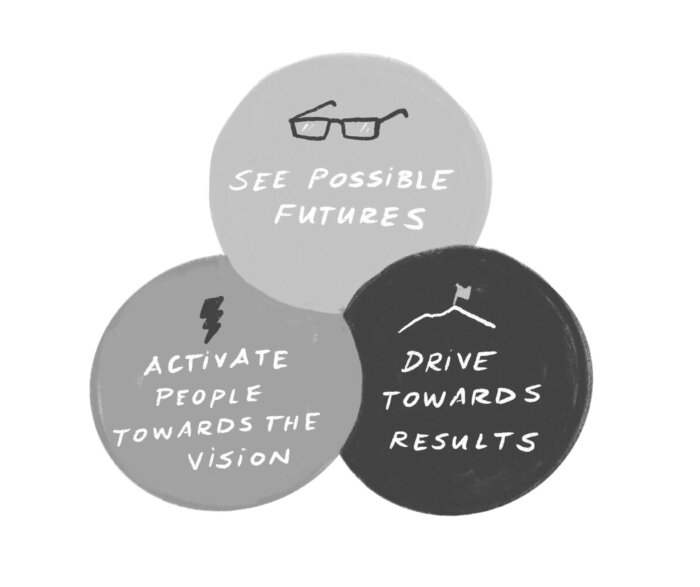
These aren’t bullet points that you find on most job descriptions.
Because of that, Catalysts can lack self-confidence, even though they often drive tremendous impact.
Getting clear on those three points gives Catalysts the language to articulate their value.
We certainly aren’t advocating for everyone to start introducing themselves to bosses, hiring managers, or colleagues as Catalysts. But once a Catalyst has self-identified, we have created tools for individuals to use in their discussions with their managers about how to set them both up for success.
Catalysts can have a large inner-critic that can be really detrimental to both our success at work and general happiness in life. We’ve been told we’re “too fast,” “too opinionated,” “too arrogant,” “too sensitive,” or just “too much.” And because we’re more comfortable with ambiguity and risk, and are often pushing people and systems in uncomfortable ways, we have more than our fair share of “failures.”
If I could offer one key takeaway from the book, it would be to practice self-compassion. We often didn’t realize how differently we operated. We didn’t know how others were receiving our change initiatives. Catalysts are, by definition, trying to improve the world.
Self-compassion allows you to give yourself the room to learn, fail, grow, experiment, and be the wonderfully unique changemaker that you are, no matter what anyone has said before.
MR: At one point or another, we’ve all had to “do more with less,” especially in response to business cycles or extraordinary events like a global pandemic. This mindset, in turn, can bring on burnout quite easily. What are you seeing now in the midst of Covid-19, in terms of trends?
Shannon: This is a big question right now. We’re living through The Great Resignation, where people are reevaluating their jobs and what they expect from their employers—including people looking for companies that actually care about their wellness—more than traditional benefits or the ping pong tables and nice lunches that are no longer relevant.
Burnout numbers (and depression and anxiety) hit all-time highs last year for obvious reasons.
What’s interesting about the Catalyst community is that even though burnout is often part of the Catalyst journey, last year we saw a lot of Catalysts actually thriving. Organizations were desperate for problem-solvers who could help them navigate ambiguity and uncertainty. Many Catalysts had seen new organizational structures, solutions, or ways of engaging with their customers that started getting attention and sponsorship after March 2020.
Our eBook, The Catalyst Innovator’s Guide to Thriving in an Uncertain World, is a collection of stories about Catalysts that helped their companies not just survive last year but actually thrive.
This is the time of the Catalyst.
MR: So, then, are we burning out even more by working from home? It’s too easy to not stop working at the end of the day in these extreme WFH times. What’s your advice?
Shannon: As mentioned earlier, burnout numbers have never been higher. The lack of boundaries between work and home, the demands of taking care of children while trying to work, taking on additional caregiving activities while having few of our normal rejuvenation activities available to us have put a massive strain on society.
During pre-pandemic times, Catalysts often suffered from burnout as part of our energy cycle while creating change. Dealing with the inevitable resistance to change can be draining, and often leads to burnout if we’re not careful.
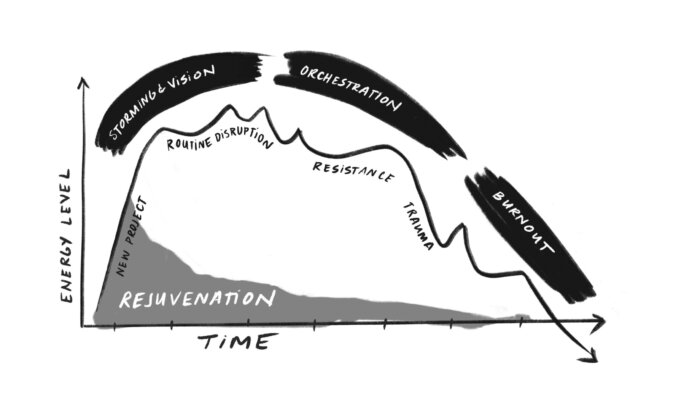
Our advice to Catalysts (and beyond) is to prioritize yourself. Put your own oxygen mask on first.
The first step to doing this is monitoring how full your energy tank is and which elements of your energy maintenance need attending to. There are lots of different types of energy reboot activities we may require.
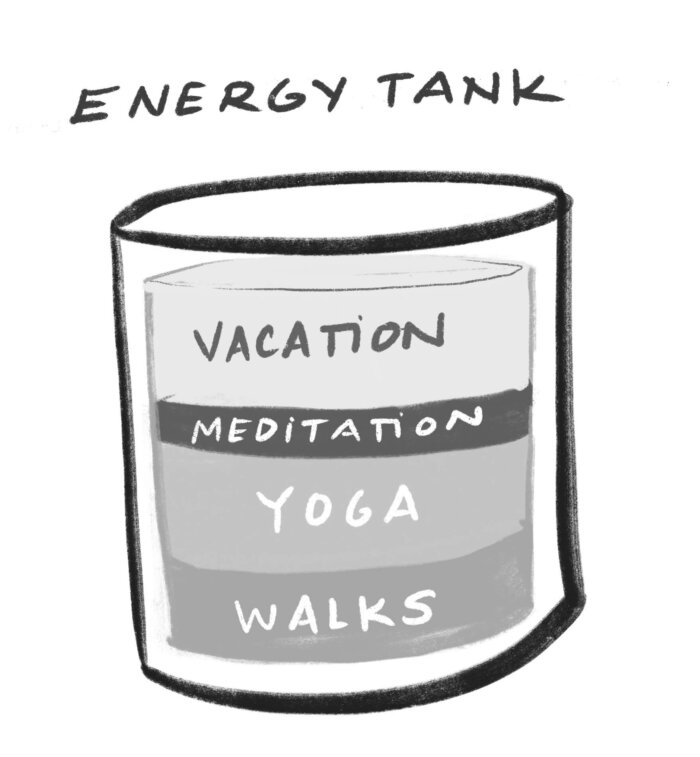
And then, once you’ve started noticing where you are and what you need, the next piece is to schedule the time for your recharge activities and put them in your calendar. Treat them like a customer meeting or meeting with your boss. Find an accountability buddy.
We know that this is all easier said than done, especially during a global pandemic.
But we also know that burned-out Catalysts create no change at all.
Once Catalysts make the connection that this isn’t fluffy “self-care” but that we are actually conduits for the change and can only be successful when we have the energy to move forward, they’re more likely to start prioritizing activities that will at least minimize cycles of burnout.
MR: That’s such a relevant and important message. What advice do you have for people looking to create positive change? How do the principles in your book apply to impact creation?
Shannon: The biggest piece of advice I can give is to maximize your empathy. As change agents, we can often be good at leveraging our empathy when we’re looking at stakeholders, customers, and citizens outside our organization. We’ll crystallize a vision based on what we’ve sensed, backed up with a lot of data, and come back in the building ready to drive hard to realize that vision.
In the process, we’ve forgotten that people have different relationships to change, and our vision might scare them. And we often forget to find the shared wins for the internal stakeholders we need to work with, to help them overcome their resistance to change and become active supporters.
Innovation is personal. Change is personal. This is why we need to meet people where they are, and take them on the change journey with us.
It’s a lot of emotional labor. And it can be easy to resent having to do all that additional work.
But if you see the change you need to make in the world, chances are high you can’t do it on your own.
Leveraging your empathy and compassion is a great foundation for creating lasting impact.
MR: Shannon, thanks so much for taking the time to speak with us and for sharing your exciting work, research, and free tools. Is there anything else you’d like to share with our readers?
Shannon: I’d love to hear from you about your journey! I know there are a lot of Catalysts in the Presidio community. Drop me a line at Shannon@catalystconstellations.com. We’re here to support you. The world needs all the super-charged Presidio Graduate School alums!
Being a Catalyst with Guests Shannon Lucas and Tracey Lovejoy
Shannon Lucas and Tracey Lovejoy, co-founders and co-CEOs of Catalyst Constellations, joined the conversation to share how organizations can drive transformation from within. They explore the role of Catalysts, the natural innovators inside companies—and why unlocking their potential is increasingly critical as organizations navigate the growing complexity of change.
Listen to the full episode here.

Never feel “successful”? You might be doing this.
If you’re a Catalyst you might never feel “successful” in your work. Like … Ever.
During my research with Catalysts I initially asked the question “What makes a Catalyst feel successful?” and after hearing a few people pause … for a long time …. and then say something like “well… Catalysts miigghhttt feel successful if, hmm, if, …” I realized it was the wrong question!
You might rarely feel successful because you are focused on systemic change and it can be difficult to gauge when systemic initiatives have been successful. Plus the timelines are looooonggg and the definition of success can become a moving target. You might even leave before the success is visible (many hear about it from colleagues much later). Or, you might reach your goals but by the time you arrive you have set new, bigger goals… so you don’t give yourself credit for having arrived.
Because you are not experiencing a sense of success and you are constantly setting more ambitious goals, you’re more likely to experience burnout and exhaustion.
Here are four tips that can help you move forward:
1. Acknowledge it’s your nature
First, know that feeling successful can be elusive and is common for Catalysts. During a Catalyst Constellations Retreat there was even a group discussion about “feeling like a fraud”.
2. Create shorter-term goals
Systemic change can be amorphous and incredibly challenging. Begin with a clear vision about what you set out to do and create shorter-term goals for yourself.
3. Celebrate completed goals
Once you reach these shorter-term goals take the time to celebrate by doing small things that bring you joy and energy.
4. Focus on different questions
I learned that better questions for Catalysts are things like: What do I feel proud of this week? What action did I take that helped push toward my Vision?
What are some of the short-term goals that you have recently achieved? What are you proud of from the last week? Would love to hear!
***
Tracey Lovejoy isn’t your typical Leadership Coach–she’s a renowned qualitative researcher with experience leading top institutions including Microsoft and the EPIC conference. Tracey has a unique ability to support your leadership journey and transform how you view your challenges so that you can continue orchestrating change in your organization. She writes regular emails that encourage, inspire, and give you a sense of community– the Catalyst Quick Tip. Click here to receive the Catalyst Quick Tip in your inbox.

Problem Framing & Vision Iteration
Welcome to 2025, the Year of the Catalyst!
January isn’t just about resolutions – it’s about revolution. If you connect the dots quickly, boldly leap into uncertainty, and see the opportunity for change everywhere – then you are a Catalyst and this is your year. Time to transform those bold ideas into measurable impact.
Being a Catalyst is exhilarating, but getting others on board to make changes can be exhausting. We get it. As Catalysts ourselves, we’ve navigated the same challenges you face, and we’ve built a toolkit to help you drive the impact you know is possible.
A great first step is to articulate your vision clearly in terms of the problem we’re solving and who we’re solving it for in a way that can easily be shared with others. Enter our Problem Framing and Vision Iteration tool. We teach this proprietary tool in our class, but you can download it here for free.
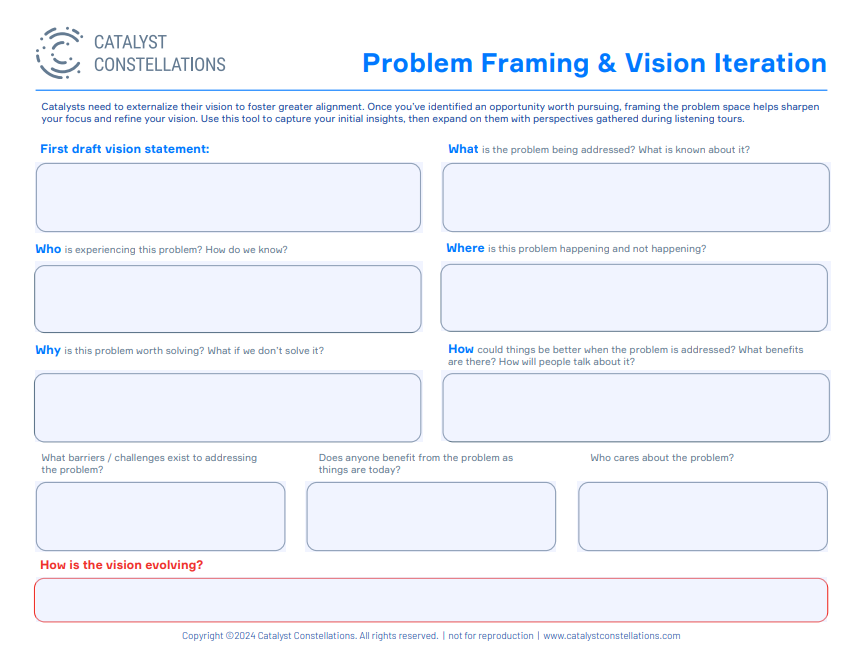
Problem Framing and Vision Iteration today. Then, check out our great podcasts on effective Catalyst communications – and overcoming resistance to change – right here.
Your ability to see possibilities others miss isn’t just a trait – it’s a superpower waiting to be unleashed. We’re excited to help you transform that vision into lasting, meaningful change.

Accelerating Strategy Activation in 2025: The Executive’s Playbook
Key Takeaways:
- Why traditional change management is failing in 2025
- How to identify and empower hidden change agents
- Building measurable transformation into your organization’s DNA
As we enter 2025, executive leaders face a stark reality: the organizations that thrive will be those that can transform at the speed of market change. Regulatory shifts, cultural evolution, and technological breakthroughs aren’t just converging – they’re accelerating. Your competitors are already responding. Are you?
This is a pivotal moment: one that demands not only the articulation of a bold vision but also the cultivation of an environment that delivers strategic change at every level of the organization.
It’s the difference between strategy creation and strategy enablement. The difference between achieving increased revenue, improved operational efficiency, and sustainable growth instead of aspiring to them. It’s the difference between hitting your goals this year and not.
The Opportunity for Strategic Change
Every organization has untapped potential for transformation hiding within its existing workforce. Yet unlocking that potential requires more than traditional change management or top-down mandates. It demands executive-level enablement: creating the conditions for rapid experimentation while ensuring measurable improvements in company results.
Toby Eduardo Redshaw, CEO of Versus Advisory, emphasizes the need to align structure and culture with strategy:
“You have to have the strategy down so you can clearly communicate the mission. Then you have to consider if your organizational structure, incentives, and disincentives match your mission.” Toby Eduardo Redshaw, CEO of Versus Advisory
Learn more about Redshaw and Versus Advisory’s culture shift in Catalyst Constellation’s podcast with him here.
How Leadership Enables Change
In 2025, the successful executive will build an environment that encourages bold exploration while empowering the organization to pivot quickly when needed. This involves:
Clarifying What Change Looks Like
- Provide strategic guidance beyond numeric revenue and new business goals to focus innovation efforts in the direction your business wants to go.
- Share your expectations for systemic process improvements in addition to executing discrete deliverables well.
- Share the goals of change: does it save jobs, improve your competitive position or increase profits? When do you expect these outcomes to materialize?
Fostering Exploration and Experimentation
- Create safe spaces for teams to test new ideas without fear of failure.
- Reward learning, collaboration, and agility as core organizational values.
Creating an Organizational Structure That Enables Change
- Seek out “hidden” leaders within your organization—those who thrive on driving new directions and strive to achieve measurable outcomes in improved ways.
- Empower these leaders with the resources, autonomy, and tools to succeed, particularly in areas that directly impact revenue, efficiency, and profitability.
- Build structures that reward behaviors aligned with your strategic goals, such as process improvements or achieving key performance indicators (KPIs).
Ready to accelerate your organization’s transformation? Access our exclusive research on how leading companies are reimagining strategic planning for 2025. Download this exclusive research here.
Are You Ready to Lead in 2025?
Are you ready to empower and inspire the change your organization needs to succeed in 2025? Ask yourself:
- How many times are changes being communicated to every employee? How far does communication reach?
- Do you have mechanisms to monitor innovation success and identify failure points?
- Are your leaders equipped to translate strategy into actionable steps that achieve measurable results? Do they have team members who can implement?
- Does your culture reward collaboration and learning?
- How are you addressing employee change fatigue and its impact on productivity?
“Developing a deeply aligned purpose and strategy, and then sharing it across the company, ensures that every employee understands their role in achieving the vision.” Julie Vens-De Vos, CEO of Nexxworks
Catalyst Constellations: Unlocking Your Potential for Strategic Change
At Catalyst Constellations, we work with senior leaders to unlock the potential of their people to drive strategic change. By empowering the Catalysts within your organization with proven tools and hands-on help, we enable you to:
- Align your entire organization around what must change and what that change means to them.
- Equip employees at all levels to take ownership of critical new goals and experiments.
- Build adaptability into your organization’s DNA, so you’re ready to meet whatever challenges tomorrow brings.
Strategic change requires deliberate action and sustained commitment. Contact us to learn how we can help.
Ready to accelerate your organization’s transformation? Access our exclusive research on how leading companies are reimagining strategic planning for 2025.