

Building Your Unique Culture of Innovation

SHARE THIS POST:

The term “innovation” often becomes a catch-all that fails to drive real business impact. The most successful organizations define innovation precisely to deliver their corporate vision, and build a culture around this understanding. Here’s how to ensure your innovation efforts deliver measurable results.

Key Takeaways 

  • Innovation means something different in every organization; clarify what it means in yours to foster a culture that delivers results instead of frustration.
  • When you clearly define innovation, you can enable, reward and measure team activities that drive your vision of success. 

Get inspired by serial CIO Ralph Loura’s journey from delivering on to defining innovation cultures in our podcast Catalytic Transformation is 99% Mindset.

Start with What

Fostering a culture of innovation is leadership’s way to focus Catalysts and ensure meaningful change and growth that is aligned with your vision and strategy. But, before you can foster that culture, you have to crystallize what innovation is. 

“Innovation” can mean everything and nothing. Without a precise definition, Catalysts will burn out themselves and everyone around them, working ideas and acting in ways that may work great in one organization but fall flat in yours. So, what should your culture of innovation look like? Different organizations define it differently. It could be:

  • An openness to new ideas and ways of working,
  • Bringing new market opportunities to leadership, or
  • Investing a set amount of time exploring future-looking opportunities

Or – it could be something else entirely. 

Step one is to define innovation. What types of innovation are important to you? Are there particular elements of your business you are looking to transform? Are there specific outcomes or goals that should be identified related to innovation or transformation? 

Last November, we sat down with Ralph Loura, former CIO at HPE and Clorox and Co-founder of Sustainable IT.org, to discuss insights from his personal Catalyst journey. Ralph provided great examples of how to foster a culture of innovation, from both sides of the leadership seat. 

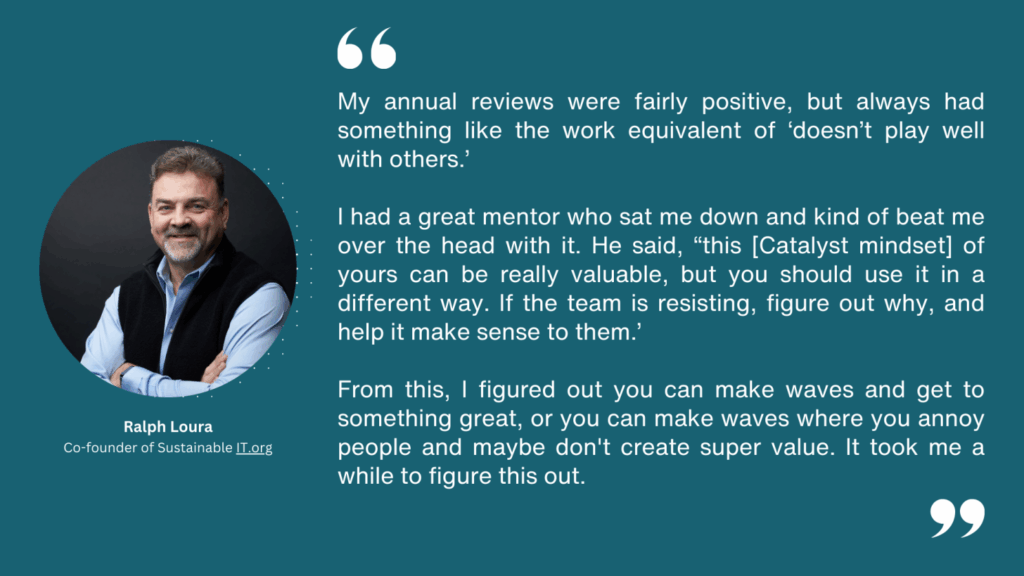
In an early role at Bell Labs, Ralph was inspired by a mentor who knew that Ralph’s Catalyst instincts were valuable, but would burn out Ralph and everyone around him unless he had guidance on what was valuable to the organization.
After you know what type of innovation culture you’re trying to build, you can determine how best to achieve it.

From What to How

With innovation defined, think about how your innovation culture should manifest itself in team behavior. Break down the skills that are helpful to the way you’d like innovation to take root. This is where your organization’s clarity on what innovation is and what it will bring to the organization is critical.

“Nobody shows up to work every day thinking, “How can I make this harder?’”  – Ralph

Let’s work with the first type of innovation – embracing openness to new ideas and ways of working – as an example. The skills to nurture and reward this innovation outcome could include openness, flexibility, agility and growth mindset; avoiding knee-jerk resistance or naysaying. In this example, leaders would teach and share examples of how to shift from resistance to openness.

Conversely, bringing new market opportunities to leadership may require instruction on market sensing and collecting market data, or how to frame a problem and create a vision others can engage with.

This clarity makes it easier to align the culture and build the skills that drive innovation, but it doesn’t happen without mindful, intentional communication.

Communication Is Key

Start by communicating, in a formal way, that innovation is important. Add it as a corporate value or core principle. Make innovation – your type of innovation – a part of how you define yourself as a company.

Posters on walls are great, but it can’t stop there. You must regularly reinforce your innovation culture with layers of communication.

Highlight where innovation is being lived regularly. Share specific examples of innovation activity in your all-hands updates and annual meetings. Establish a quarterly peer reward program and take every opportunity for informal shout-outs. All of these are great tools to reinforce innovative behaviors from different directions, creating a holistic environment of both safety and expectation.

Later in his career, when he was CIO at Symbol Technologies, it was Ralph’s turn to focus the team while creating the space for innovation. He was charged with completely overhauling the supply chain, reporting and product lifecycle management processes – and he learned a big lesson in building innovation culture:

“We created an internal marketing campaign called, ‘imagine a Symbol where…’ sharing all these things we were trying to accomplish. We had this big launch, and we went through a half day event. And the team – didn’t get it. I was frustrated.

John Bruno, our CMO, pulled me aside and said, ‘how long did it take you to get to this point of clarity? You’ve been working on the campaign for four months and then you give them four hours to get there.

They needed time to catch up, so I spent a bunch of time working on mindset – working on getting them caught up and on board. How will we do this? Why do I believe that? Connecting all the dots, and that made a huge difference, and we delivered.” – Ralph

Measure What Matters

Finally, measure how and where innovation is taking hold. This could be how many new ideas come to leadership, or how many new ideas are implemented. Or it could be a metric on how open and agile team members are. You need data to understand whether you are or aren’t changing to help course correct actions and share progress with the team.

But truly successful innovation also requires concrete metrics tied to business outcomes. Focus on things like:

  • Revenue impact from new initiatives
  • Operational efficiency gains
  • Customer satisfaction improvements
  • Employee engagement scores
  • Speed to market for new offerings

With measurement, you can also add rewards for team members who are embracing your innovation culture.

A culture of Innovation is a living, iterative way of being that should reward effort and expression as well as more tangible outcomes.

Leading the Innovative Culture

Innovation delivers value when it’s clearly defined, properly resourced, and measurably tied to strategic objectives. The key is identifying and empowering the right people within your organization to drive these initiatives forward.


Want to learn more about driving strategic innovation in your organization? Access our latest research and insights:

Contact us to discuss how we can help you achieve your boldest strategic initiatives.

Developing Your Next Generation of Change Leaders

SHARE THIS POST:

Key Takeaways:

  • Catalyst Constellations’ research revealed clear skill differences between Junior and Executive Catalysts as they journey toward making an impact.
  • To maximize Catalyst impact, help them build these key skills: strategic prioritization, deep listening, and the ability to co-create.
  • Mentoring a Junior Catalyst requires honesty and a commitment to telling hard truths, but must be founded in absolute trust. Create a psychologically safe space for success.

Upskilling Your Junior Catalysts

Mentoring a Junior Catalyst isn’t just talent development—it’s protecting a valuable organizational asset. These change agents see possibilities others miss and drive toward those possibilities relentlessly. But without strategic guidance, they can burn themselves out pushing low-priority initiatives or even get rejected by the system before making a meaningful impact.

Our latest research confirms that the evolution from Junior to Executive Catalyst depends on developing specific skills that amplify their natural catalytic strengths. As their leader, you need to help them harness their transformative energy without extinguishing their fire.

The Patterns That Separate Junior from Executive Catalysts 

When our Catalyst Leadership Trust executives reflected on the workflows of their most successful projects, our research team identified distinct patterns that separated high-impact Catalysts from those who remained trapped at the junior level—regardless of title. 

The output of these efforts is the visual representation below, which lists the different skills of the Executive vs Junior Catalyst at each stage of a Catalyst’s journey toward making an impact:

By guiding Junior Catalysts to develop their Executive Catalyst skillset, you’re not just shaping a future executive. You’re ensuring that their unique ability to make an impact doesn’t get lost, but instead grows into something that can transform organizations at the highest level.

And that? That’s what true leadership is all about.

Continuing the Conversation:

Want to learn more about upskilling Junior Catalysts in your organization? Access our latest research, offerings and insights:

Contact us to discuss how we can help you achieve your boldest strategic initiatives.

Networking Innovation from Spark to Scale

SHARE THIS POST:

Key Takeaways:

  • The majority of transformation initiatives fail because they lack the right network strategy across discovery, development, and diffusion
  • Place innovators at the edges for discovery, in focused teams during development, and leverage them as bridges during diffusion
  • Create horizontal momentum through peer networks before formal rollouts to overcome organizational resistance

Breaking Through Organizational Inertia

Innovation isn’t stalling because of idea quality—it’s failing at the critical moment of organizational adoption. How can you not just spark innovation, but scale it?

Michael Arena, PhD (Dean of Crowell School of Business and former executive at GM, Amazon, and Bank of America) recently shared research with our Catalyst Leadership Trust that confirms much of what we’ve seen at Catalyst Constellations: disruptive change is as much about who you engage—and how— as it is about the brilliance of the idea itself. 

When Innovation Cashes Out: Lessons from Bank of America

Arena’s own journey began at Bank of America, where he co-led the Center for Future Banking. With support from MIT Media Lab, his team developed five promising ventures, some of which went on to generate billions in revenue. But here’s the kicker: none of those innovations were adopted by Bank of America.

“Why didn’t these great ideas – ideas that made others billions – get adopted? The organization’s “antibodies” rejected them.” – Michael

Despite executive approval, investment, and press buzz, these ideas were killed by internal resistance. The not-invented-here mindset, entrenched silos, and risk aversion snuffed out innovation at the exact moment it needed organizational support to scale. A scenario familiar – and frustrating – to us Catalysts.

This failure led Arena to ask: What really enables innovation to take root inside complex organizations?

The Answer: Social Bridging

After analyzing 60 innovations across companies like Adobe, IBM, and Google, Arena’s research uncovered a clear pattern: successful innovation wasn’t about better ideas. It was about better networks.

The differentiator? Executives who strategically positioned themselves as network bridges across organizational boundaries. Steve Jobs exemplified this approach, sitting at the center of Apple’s patent network—not with the most connections, but with the right ones that connected otherwise isolated innovation clusters.

“It may have been Steve Jobs’ network, not just his genius, that made him a great innovator,” said Michael. 

Three Phases of Innovation: Three Opportunities to Influence

Arena’s work breaks innovation into three phases – Discovery, Development, and Diffusion – each requiring a different network structure and leadership approach. 

1. Discovery: Break the Bubble

$2.3 trillion has been wasted globally on unsuccessful transformations. To avoid this fate:

  • Inspire yourself and others with “Think Big” challenges, but clearly define “big”
  • Move innovation teams to organizational edges—like GM did by sending teams into urban centers to understand mobility beyond traditional truck buyers
  • Resist micromanagement—discovery requires freedom, not oversight

2. Development: Shield Your Catalysts

This is where ideas transform into testable prototypes. This phase is about momentum, not consensus, so your focus will be on giving the innovation team the space they need to bring the idea to life. 

  • Form autonomous, cross-functional teams with minimal dependencies – like Amazon’s famed “two-pizza” teams
  • Maintain organizational distance while providing resources and air cover
  • Keep exploration informal—premature executive visibility creates unnecessary pressure

Real Impact: At MVP Health Care, our Catalyst program enabled five cross-functional teams to deliver breakthrough innovations—from reducing claims processing time by 60% to positioning the company in the rapidly growing caregiver support market.

3. Diffusion: Build Trust Networks, Not Just Rollouts

This is the make-or-break phase where most innovations die. Your team has been living and breathing these ideas for weeks, maybe months. It’s hard to understand why everyone doesn’t immediately “get it,” so your role is critical:

  • Activate peer influencers first—what Arena calls “energizers”—who can validate innovations horizontally
  • Create informal showcases to build organic excitement—GM used “Innovation Showcases” with beer and popcorn. No formal agenda—just demos and conversation. As Arena jokes, “It takes a few beers to make great wine.”
  • Remember this is co-creation, not selling—encourage your team to validate the innovation with the skeptics in their organization, and to not just listen but learn. 

“Diffuse horizontally first—then let the energy and excitement bubble up.” This strategic sequencing allows innovative sparks to grow from idea, to production – to policy.

Transform Your Innovation Approach Now

Organizations that master these network dynamics don’t just create innovations—they create transformation engines that continuously adapt to market shifts.

Join executives from Chobani, TIAA, CBRE and other forward-thinking organizations in the Catalyst Leadership Trust, where we’re building the next generation of transformation leaders. https://mc.catalystconstellations.com/cltfullbrochure

Ready to unleash your organization’s hidden Catalysts? Contact us to learn how we’ve helped companies achieve measurable results on their boldest strategic initiatives.

How to create a workplace where changemakers thrive

SHARE THIS POST:

This article originally appeared in Fast Company on June 25, 2025. Article written by Tony Martignetti and Shannon Lucas.

Innovation doesn’t happen in silos: it happens in systems. And yet many companies still rely on lone heroes to ignite transformation. 

They recruit visionary thinkers, celebrate bold ideas, and preach agility, but beneath the surface, their structures reward predictability and punish deviation. As a result, the very people most capable of driving innovation—fast-moving, future-oriented changemakers known as catalysts—are often left isolated, misunderstood, and burned out.
Catalysts ignite possibilities. They challenge the status quo, connect seemingly unrelated dots, and accelerate momentum. But they don’t thrive in traditional organizational ecosystems because they threaten bureaucracy, resist incrementalism, and without support, they either burn out or leave.
According to Gallup, just 21% of employees strongly agree that they can take risks at work without fear of negative consequences. As Shannon Lucas and Tracey Lovejoy explain in their book Move Fast. Break Shit. Burn Out., these workers often struggle with intense isolation and exhaustion not because they aren’t capable, but because the system isn’t designed for them to succeed.

To unlock sustainable innovation, organizations must evolve from celebrating individual disruptors to cultivating ecosystems where diverse changemakers—catalysts, stabilizers, implementers—can thrive together. This isn’t a culture tweak. It’s a systems redesign.

The 4 Layers of a Catalyst Ecosystem

Shannon and I have seen how catalytic energy can drive exponential growth if the right conditions exist. This framework outlines the four interdependent layers that support thriving catalyst ecosystems.

1. Identification: Spot the Sparks

Catalysts don’t always stand out on paper. They’re often the ones asking provocative questions in meetings, proposing ideas that seem off-script, or moving faster than the rest of the system. But without intentional practices, these traits can be seen as disruptive rather than visionary.

To find them, leaders must look beyond the org chart. Psychometric assessments, cross-functional feedback, and structured self-discovery tools can help you to illuminate hidden change agents at every level in your organization. You can also train managers to spot curiosity, systems thinking, and pattern recognition.

In her work with large organizations, Shannon uses her company’s Catalyst Assessment Tool to uncover innate changemakers hidden throughout the business. This often-overlooked talent is frequently underutilized. At one company, 60% of the employees identified as catalysts were previously considered “hidden talent” by the C-suite—and they went on to solve some of the organization’s most pressing challenges.

2. Integration: Design for Complementarity

Once identified, catalysts need more than autonomy. They need meaningful integration with the broader system. Pairing them with stabilizers (who bring operational excellence) and implementers (who drive execution) creates cross-functional “change pods” that balance energy, tempo, and sustainability.

To unlock sustainable innovation, organizations must evolve from celebrating individual disruptors to cultivating ecosystems where diverse changemakers—catalysts, stabilizers, implementers—can thrive together. This isn’t a culture tweak. It’s a systems redesign.

In my work facilitating story-based leadership circles, catalysts often emerge through narratives of disruption, such as career pivots, reinventions, and vision quests. However, their breakthroughs become organizational breakthroughs only when they are translated into a shared purpose. 

This requires redesigned team norms: tempo-matching, structured conflict mediation, and deep respect for different working styles. Catalysts are the spark, but the team is the engine—and the organization is the road they need to travel together.

3. Protection: Shield the Flame

A large amount of pressure to innovate without adequate support is a recipe for burnout. According to Deloitte, innovation-driven employees are 2.5x more likely to leave if they lack proper support systems. Catalysts in particular are prone to emotional exhaustion, especially when their efforts are blocked by bureaucracy or misunderstood by leadership.

Organizations must build containers that buffer catalytic energy. This means establishing sponsorship structures, recovery protocols (such as off-cycle sabbaticals or reflective retreats), and psychological safety as a norm. This could include internal coaching circles, energy mapping, or check-in rituals that normalize emotional processing. Investing in resilience practices isn’t a perk; it’s a prerequisite for sustainable change.

4. Amplification: Scale the Spark

Catalysts can’t just be unleashed; they must be amplified. 

Invite them to inform strategic offsites, facilitate internal labs, or lead cross-functional storytelling initiatives. Establish formal channels, like “Catalyst Councils,” to elevate their insights into enterprise-level planning. Codify what they learn. Translate their experiments into onboarding content and playbooks. Make space for them to coach emerging catalysts in the system. When you treat catalysts not as rogue actors but as cultural accelerants, their energy becomes contagious.

In a Catalyst program with a large healthcare organization, Shannon worked with the team to identify, train, and activate catalysts from across the business. The program participants were given the most pressing strategic initiatives to tackle. In just 16 weeks, the Catalyst participants helped the company reduce reimbursement times from eight weeks to just two days, a 96% improvement, driving significant gains in both customer and employee satisfaction. Additionally, the organization reported a 24% improvement in change leadership capabilities across the enterprise. This is the power you can unleash and amplify by engaging your catalysts.

Innovation isn’t a solo act; it’s an emergent phenomenon. It happens when diverse roles, energies, and mindsets interact in the right environment. That means building systems that reward exploration, reframe conflict, and move ideas from the margins to the center.
The future won’t be led by lone geniuses. It will be shaped by ecosystems that can accommodate differences, adapt rapidly, and nurture catalytic energy over the long arc of change. Don’t wait for a crisis to value your changemakers: Design for them now, and your organization won’t just survive change—it will shape it. The next time someone in your organization brings an idea that feels risky or “too soon,” pause before you dismiss it. Ask: What if this is the spark we’ve been waiting for, and how might we build the right conditions to let it burn bright?

Co-Authors: Tony Martignetti and Shannon Lucas