Stop Treating AI Like Software. Start Treating It Like Your Newest Hire.

SHARE THIS POST:

Who’s the New Guy?

AI isn’t a magic wand or silver bullet. It’s your newest team member, one that happens to be lightning-fast, infuriatingly literal, and prone to making things up when confused.

Last month, the Catalyst Leadership Trust assembled to discuss our partner Samudra Group’s AI Odyssey report, diving into how organizations can actually thrive in the age of AI. The session brought together C-suite executives, industry leaders, and transformation experts to uncover what’s really working.

The consensus was clear: to realize AI’s value, treat it like what it increasingly resembles: a new type of employee. That means onboarding it with intention, structure, and clear expectations.

Set Up AI’s Workspace

For AI, this isn’t about desk assignments. It’s about ensuring the data your AI will use is actually usable. If your data systems are chaotic, AI will be confused. When confused, it hallucinates or shuts down entirely.

The reality: AI governance adds 10-20% to traditional oversight budgets. Factor this into your business case now.

Action: Start with one clear use case, like customer service for a single product line. Build solid data architecture, access controls, and tagging around that specific workflow.

Give AI a Job Description

You wouldn’t hire an executive and say, “figure it out.” Yet that’s how many companies deploy AI, without defined use cases, boundaries, or success metrics.

Accenture got this right with their AI-powered Proposal Builder. Clear mission: reduce proposal creation time from hours to minutes while improving customization. With that focused scope, they could set goals and coach the system toward success.

Result: 50% productivity boost with measurable improvements in brand consistency and personalization.

Action: Define what AI owns and what it doesn’t. Set boundaries, deliverables, and dependencies just like any critical role.

Put AI on Cross-Functional Teams

AI works best as a collaborator, not a solo performer. Research shows human-AI teams outperform both humans alone and AI alone by 12-17%.

Colgate-Palmolive pairs product teams with AI systems to review market data for new opportunities. The humans aren’t just auditing, they’re actively shaping outputs. The result? Broader innovation funnels and faster time-to-market, with zero AI disasters.

Action: Reconfigure teams so AI isn’t sitting alone in a tool stack. Assign it to cross-functional units where humans validate, improve, and direct its work.

Measure AI Like You Measure People: with KPIs

ROI and internal AI adoption rates are good metrics. But, if AI is an employee, you should measure performance with business contributions such as output quality, accuracy, and speed of service.

Swedish fintech Klarna integrated AI across innovation teams with shared KPIs. Results? 60% faster go-to-market cycles and 59% faster innovation rates.

Action: Set performance metrics that measure real business impact. Evaluate and iterate like you would with any high-potential hire.

The Real Transformation Ahead

AI is powerful, but it’s not plug-and-play. Organizations that onboard AI with the same rigor they apply to executive hires will see the real returns: smarter teams, faster execution, and better outcomes.

But here’s what we’re learning: the technical implementation is just the beginning.

In a recent workshop with healthcare executives, we asked a simple question: “What percentage of AI transformation is cultural versus technical?” The overwhelming response: 80% cultural, 20% technical.

So while you’re onboarding AI as your newest hire, ask yourself: How will you help your existing team embrace this new colleague? How will you maintain customer confidence as AI becomes part of their experience? And most critically, how will you ensure this transformation accelerates your boldest strategic goals rather than just adding another layer of complexity?

#AITransformation #ExecutiveLeadership #OrganizationalChange #Innovation #FutureOfWork

The power of clarity of vision

SHARE THIS POST:

A few months ago, John Morley would tell you that he had a “smorgasbord of ideas” regarding his career. But two weeks ago, he got every catalysts’ dream job. John used the power of clarity of vision to get where we wanted to go.

His job description is literally to change an organization—John is a Business Design Strategist at Hitachi Vantara (a subsidiary of Hitachi). He works alongside the CTO, to “catalyze” the organization—to move forward with its digital transformation agenda, and to explore new things.

How exactly did he get there?

Identifying as a Catalyst

John says his journey began when we met, and he understood the value of his specific skill-set: to see the big picture and identify where he can make logical and likely connections. In an approachable and slightly Irish accent John says he’s, “sort of a wheeler and dealer… I listen to people, find out what they’re working on, and I say ‘ooh, there’s someone over there that you should go talk to’.” You can hear the excitement in John’s voice as he talks about organizational transformation and getting others on board. We call people like John, catalysts.

Clarity of Vision

Earlier this year, John experienced an important mindset shift at the Catalyst Constellations Retreat. He identified his personal mission and vision, and was able to prioritize his next steps based on this mission. John said that the retreat’s funnel structure helped him narrow his broad vision into specific next steps.

Rejuvenation & Connection

The retreat was a “significant accelerator” for John. Clarity was part of it, but so were restoration, and connection to others like him. In our interview, John describes how a long walk by the beach and a “catalytic” meditation taught him how taking breaks can lead to personal empowerment. And how meaningful it was to feel part of a greater whole, like at a BBQ under the stars when a fellow catalyst came up to him and said, “I love your energy.” This was one of many moments that enabled him to embrace his vulnerability and get in touch with his needs to be a more effective change agent. “I keep using the word catalyze, but that’s really how I think about it, so there you go,” he says.

Catalyzing Your Personal Journey

Shortly after the retreat, John met up with a former colleague who now works at Hitachi. “He asked me come work with him and do what it is I do”, says John with a warm smile. “That was a great personal moment for me, because that came directly from the retreat”.

The Smallest Investment… In Yourself

SHARE THIS POST:

We need to talk about the smallest investment in yourself. Because so many people struggle with too much work. From burnout.

People who identify as change agents are often doing their catalytic work, in addition to their day job, which can increase the feeling of burnout.

Making the investment

One of my favorite TedTalks by Nigel Marsh speaks to the issue of finding ways to sustain ourselves and make time for the things that are most important in our lives.

“Being more balanced doesn’t mean dramatic upheaval in your life. With the smallest investment in the right places, you can radically transform the quality of your relationships and the quality of your life. Moreover, I think, it can transform society.”

This is a big part of the reason why we created Catalyst Constellation. And specifically Catalyst Constellations’ retreats.

Retreats are designed with rejuvenation in mind; a beautiful setting, great food, mediation, yoga, hikes. It’s the gift of a few days for change agents to come together with a tribe who understand the specific energetic challenges of catalytic work.

Together we (re)commit to rejuvenation practices (small and large) to help sustain ourselves and our work. Participants leave with an ongoing peer group to support each other on the journey of finding “balance” and continually committing to investing our time in the right places.

The retreat also focuses on clarifying your vision and creating an action map. You don’t just leave rejuvenated; you have a concrete path forward to focus your renewed energy. The cohort co-creates and refines each individuals’ plan; leveraging the wisdom of the group to accelerate your progress after the retreat.

As change agents we need to sustain ourselves because the work we are catalyzing is important. We’re creating positive, lasting change in the world. We invite you to connect with us to find out more about this amazing opportunity to invest in yourself and your work.

Never feel “successful”? You might be doing this.

SHARE THIS POST:

If you’re a Catalyst you might never feel “successful” in your work. Like … Ever.

During my research with Catalysts I initially asked the question “What makes a Catalyst feel successful?” and after hearing a few people pause … for a long time …. and then say something like “well… Catalysts miigghhttt feel successful if, hmm, if, …” I realized it was the wrong question!

You might rarely feel successful because you are focused on systemic change and it can be difficult to gauge when systemic initiatives have been successful. Plus the timelines are looooonggg and the definition of success can become a moving target. You might even leave before the success is visible (many hear about it from colleagues much later). Or, you might reach your goals but by the time you arrive you have set new, bigger goals… so you don’t give yourself credit for having arrived.

Because you are not experiencing a sense of success and you are constantly setting more ambitious goals, you’re more likely to experience burnout and exhaustion.

Here are four tips that can help you move forward:

1. Acknowledge it’s your nature

First, know that feeling successful can be elusive and is common for Catalysts. During a Catalyst Constellations Retreat there was even a group discussion about “feeling like a fraud”.

2. Create shorter-term goals

Systemic change can be amorphous and incredibly challenging. Begin with a clear vision about what you set out to do and create shorter-term goals for yourself.

3. Celebrate completed goals

Once you reach these shorter-term goals take the time to celebrate by doing small things that bring you joy and energy.

4. Focus on different questions

I learned that better questions for Catalysts are things like: What do I feel proud of this week? What action did I take that helped push toward my Vision?

What are some of the short-term goals that you have recently achieved? What are you proud of from the last week? Would love to hear!

***

Tracey Lovejoy isn’t your typical Leadership Coach–she’s a renowned qualitative researcher with experience leading top institutions including Microsoft and the EPIC conference. Tracey has a unique ability to support your leadership journey and transform how you view your challenges so that you can continue orchestrating change in your organization. She writes regular emails that encourage, inspire, and give you a sense of community– the Catalyst Quick Tip. Click here to receive the Catalyst Quick Tip in your inbox.

Tools Catalysts Need to Thrive

SHARE THIS POST:

The moment you self identify as a Catalyst can feel like a lightbulb moment, sometimes for a light that we didn’t know had burned out. The first thing many people tell us is how relieved they are—that they always thought they were “crazy,” and how excited they are to finally have words for the way they operate in the world. But despite this lightbulb moment many of us don’t even know if we have the tools to thrive.

Why is this realization so important? Because as Catalysts, we think and act differently than most. Sometimes those differences are welcomed and celebrated, and other times we’re written off as disruptors or troublemakers. 

Catalysts see interconnected data everywhere we look, and that data often points to potential change that we’re motivated to set in motion—even if the people around us don’t yet see that same vision. Once the early, exciting phase of a project is under control, we tend to get bored and would rather hand off projects to someone else than see them all the way to the more mundane levels of completion. 

For the non-Catalysts among us, we’re sure you can relate to the frustrations of working with someone who seems to jump around or shift the goalposts or start something and “never finish.” 

You’ve probably also felt the positive sides of that interaction as well, when someone seems to work magic as they pull strings and make connections to achieve an extraordinary goal.

Sometimes it feels like magic to us as Catalysts, too—or at least like a normal way of being. 

    • Doesn’t everyone see what I’m seeing?
    • Don’t you all want this better future to happen?
    • I thought we had agreed to turn left—why is everyone going to the right?

And other times, we feel just as chaotic as we look. That’s why finding out we’re not broken, we’re not crazy, and we’re not alone is such a remarkable experience.

But once the realization that you’re not broken sinks in, the next questions often start with “how…” 

    • How do I share my vision without scaring people away? 
    • How do I moderate the pace of change when I didn’t even know it was too fast?
    • How do I build partnerships and bring people along? 
    • How does a Catalyst thrive—in the workplace, at home, and in the world?

Recognizing your Catalyst superpowers (and weaknesses) is only the beginning of the journey. Honing and articulating them is a lifelong process—one that we’re working on together at Catalyst Constellations. 

We believe that by understanding more about how you move so quickly, why you are more willing to break things in service of a better future, and what causes you to burn out with more frequency than your peers. 

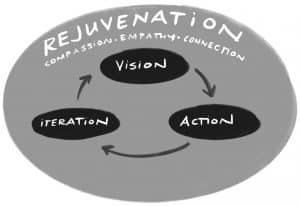
Our research shows that Catalysts have an innate process and way of moving through the world, called the Catalyst Formula. It includes three phases —Vision + Action + Iteration—encased in and powered by rejuvenation.

A graphic showing a circle with the title rejuvenation and the concepts of vision, action and iteration inside the circle

Our book details this process step by step, like looking under the hood to see what makes a Catalyst go. In our Catalyzing Organizational Change course, we take it a step further. Over six weeks, we walk through each component of the formula with small groups of Catalysts as they learn to apply those particular types of strengths in new ways, with stronger intention. Beyond simple analysis, we work alongside each other to develop the necessary catalyst muscles to more effectively create the change we need to see in the world. 

The more familiar we become with the Catalyst Formula, the clearer we see it in motion every day of our lives, the better we can harness it. So let’s unpack a few key tools, one for each aspect of the Catalyst Formula, that can help you thrive as a Catalyst, no matter what kind of change you’re manifesting in the world.

Learn to Articulate the Vision

When we talk about Vision with Catalysts, it’s a little bit different than the way the general population thinks of it. This Catalyst superpower is not necessarily about a singular goal or ultimate finish line to drive toward. It’s an entire mode of thinking that we never shut down.

Our tentacles are always out there, feeling for what seems like limitless possibility. We’re gathering data not just in our literal research, but as we read a room, have conversations, learn more about our organizations, and become inspired by creative works. 

We constantly pull this information in, from all sources, and that’s when the “magic” seems to happen. Our ability to connect the dots makes all of those disparate sources equally informative. The message in a science fiction novel connects to the concern a colleague had which connects to the stats a research team just compiled…and it all points to the solution to the gap in the organization that we’ve been trying to sort out.

But this happens so naturally and so clearly for us that we often just go after that solution, not realizing we’re the only ones who took that mental journey from point A to point Q all in an instant.

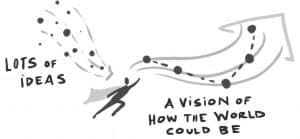
A cartoon super hero looking at "lots of ideas" and a vision of how the world could be

No matter how clear our visions for a better future are, most of us don’t know how to communicate that vision to anyone else.  

In order to bring people along, we have to be able to show them where we’re going. And often, that must begin before the vision coalesces. In other words, sharing the vision begins with listening first. 

The Listening Tour is a key Catalyst tool for shaping a clear vision that involves the people around you.

Take a period of time to simply listen and observe. Try to understand the context, challenges, needs, and success criteria of stakeholders across your organization. Be intentional in your conversations—about who those conversations are with and what opportunities or concerns you cover—to gather data to inform your vision. Ask them open ended questions and give them the time and space they need to share an in-depth view of their world. Focus on listening for deep understanding. 

Not only is this a source of data for you as you’re connecting the dots toward that ultimate goal, but it helps the people around you appreciate at least a piece of the process as it unfolds. Taking the time to truly understand your stakeholders’ situation is a great way to start cultivating your vision in a way that invites cooperation. When they see their input in the vision you eventually share, it won’t seem quite so disruptive.

And, as simple as it sounds, remember to actually say your vision out loud once you come to clarity on it. Over and over and over again.

It’s common for Catalysts to move forward into action, after barely taking the time to fully form the vision in their minds—what it would look like once complete and who it would impact along the way—much less externalize it. 

A cartoon representation of your uncertain future represented by a blur and a Catalyst's certain future represented by glasses

Take time early on to meet with someone “safe” (preferably someone who isn’t going to be impacted by the vision) and say it out loud to them. Get a feel for what that’s like. Make the case for it. Let them challenge you. Again, you’ll gain more data, and you’ll have a better idea of how to present it to stakeholders once it’s time. 

Create and Use an Action Map

There is little on this earth more powerful than a Catalyst who can articulate and externalize their vision. Creating an Action Map is one of the best ways we ensure that vision has a chance to become reality. 

This is one of the more concrete and helpful tools in the Catalyst’s arsenal, and one that we use every time we set out to create something new. 

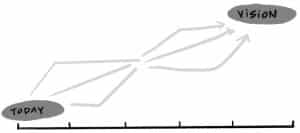
It’s exactly what it sounds like: a map of actions to be taken on the way to a vision. If you are here—what does your vision look like, when should it come to life, and what key stops are you going to have to make along the way?

The Action Map is helpful as a visioning tool, asking us to become more specific and clear about what it is we’re driving toward. 

It’s a regrounding tool, asking us to stay focused as we move into action and begin to iterate on our planned steps. 

And if we plot our own personal needs on it as well, it’s a rejuvenation tool, asking us to think of ourselves as whole people and not just vehicles for change.

The goal of an Action Map is to track your intended path so that the whirlwind of iteration doesn’t take you away from it.

Once you’ve built an Action Map, keep it front and center. It should become a key tool that you use to prioritize your time and recap your accomplishments, even as you move forward in that non-linear way that most Catalysts are prone to. It can also become a reference point that helps other people know what you’re doing too. 

You might create your Action Map on a spreadsheet, jot it down in a journal, or sketch it out with drawing tools. The actual format of the map isn’t important. What matters is whether you can use it to check in on your vision—updating it as needed, of course—and stay focused on the steps that will get you there. Keep your original Action Map and all subsequent versions to document the journey you’ve been on and the pivots that you’ve made based on input and data that you’ve gained along the way. 

Count the Wins (and Losses)

In spite of the remarkable levels of change Catalysts are able to create, we don’t often feel successful. We move so quickly past our original (poorly articulated) goals that we forget how far we’ve come to get there. 

That non-linear way of working tracks as constant effort without often registering as success. Yet when we look back on the previous year, we often find ourselves in a completely different place than where we started, with much progress being made, even if sometimes it was just helping the team come to clarity on “What next?”

This makes celebration another key tool for Catalysts to thrive—not just in the completion of a vision, but in the everyday small stuff.

A cartoon of a stick figure looking at a wall with tons of black and white sticky notes on it

When you make an Action Map, you’re not just pointing the compass to the true north of a vision and setting out toward it. You’ve identified clear steps that will have to be taken along the way. Progress along that map is worth celebrating. Appreciate what you’ve accomplished, whether it’s landing that key meeting or clearing out those old files that held important information.

Similarly, you’re going to hit hard losses—maybe even on steps you were counting on being a win. Those are worth appreciating as well, because even failure is a form of information that can help you move forward. Reframing failure in this way is a key part of the successful Catalyst’s journey. 

The losses can still hurt. You can still feel them and experience the consequences. But you don’t have to get stuck there. 

Articulating the wins and losses, both as they happen and in retrospect, is important not just for you but also for your team or partners. We constantly find ourselves reminding each other to celebrate the small stuff and to look for the win that’s hidden in a loss. We try to toast the easy wins as much as the hard ones, because they’re only easy when they come on the heels of other wins we blew right past.

Learn to mark those moments that move you forward, even when they feel like a setback. Share the moment with people around you, so that they can learn to reframe failure and celebrate progress as well.

Over time, you’ll find that small but consistent moments of celebration or acknowledgment will keep others on the journey with you where they might otherwise feel left behind. And even if you’re all alone, they’ll help you create space to breathe for a moment and enjoy the work once more.

Track Your Energy

Embedded within each of the other key tools is this quiet reminder that you matter too

A vision doesn’t come together as well if you aren’t present in each of your interactions with people and data and inspiration. 

An Action Map isn’t as effective if the things you need as a person aren’t on at least a few stops as well.

Wins and losses are important for the team, but it’s just as much about your own satisfaction—reminders of how much joy this work actually gives you.

That’s where the final piece of the formula comes in, even though it’s more like a bubble encasing the whole Catalyst Formula within it. Rejuvenation is the slow burning fuel that makes the Catalyst keep running. Without it, we might burn hot, but we’re going to burn out fast. 

We can become so externally focused on the change, that we forget to think about ourselves. That’s why so many of us hit exhaustion and burnout more deeply and with more frequency than non-Catalysts. The work that once gave us energy begins to take away from everything else that gives us energy, until all it does is take. Eventually, we have nothing left to give.

To start a practice of rejuvenation, start by simply tracking your energy.

What’s giving you energy and what’s taking it away?

Do you see a pattern of energy-draining or sustaining tasks? What about interactions? Is your role still one that brings you life and joy? 

Image of a cartoon energy tank for a human with levels listed as vacation, meditation, yoga, and walks

Because rejuvenation encompasses the whole Catalyst Formula, that awareness can affect each of the other tools, too. As you build your vision and map it out, consider what kind of energy you’ll have on the other side and what you’ll need to sustain it along the way. As you prioritize your day or week or month against the Action Map, think about what gives you energy and find a place for it on the map. When you hit a big win, use that energy as fuel to get you through a lower spot around the corner.

The Thriving Catalyst

No, these tools aren’t going to solve everything. You’re still going to move too fast, frustrate people and become frustrated, and lose more energy than you gain. You’re most likely going to burn out. 

The difference comes with the level of intention that the tools create. 

    • The Listening Tour helps you shape a more well-rounded vision that others can see themselves in, and articulating that vision out loud helps you set off in a more specific and clear direction.
    • The Action Map gives you a guiding star to prioritize by, to hold focus when iteration threatens to carry you away or when the midpoint starts to get tedious and boring.
    • Celebration of wins big and small—and of what you learn from losses—brings energy and satisfaction back into the process of work itself.
    • And when you track your energy, you’ll see even more of what feeds you as a Catalyst or seems to drag you down.

And that’s really the heart of it all: the tools you need the most are the ones that will help you thrive. You don’t have to fit anyone else’s expectations of what visioning looks like or what should or shouldn’t be energizing. You just need to live up to your own incredible potential, inside and out.

Because when you know that you’re a Catalyst—not a broken mess…

When you know you’re tracking toward a specific vision—not just making “magic”…

When you can see the map of actions that will get you there—holding yourself to your priorities instead of chasing every shiny new adventure…

When you can look back on your progress and celebrate clear wins and mark important losses—bringing your team along as pivots happen instead of jumping ahead alone…

When you can track your energy and truly value yourself as a key part of the changemaking process…


честные казино с быстрыми выплатами
бездепозитные бонусы казино
играть в лучшем казино на деньги
база казино с бездепозитным бонусом
онлайн казино России
casino oyunu

…That’s when you shift from surviving the world as a disruptor to changing it as a powerful, thriving Catalyst.


For more tools and exploration of how Catalysts work, get your copy of Move Fast. Break Shit. Burn Out. To build your Catalyst muscles with the community, our next Catalyzing Organizational Change course kicks off soon

Orchestration: The Catalyst Achilles Heel

SHARE THIS POST:

What do you know about Orchestration? If you resonate with the title of Catalyst you should worked on being versed on the concept because orchestration is very likely achilles heel for most Catalysts.

When we met Gabe (pseudonym) he was new in a design research role. He was confident that design research methods would help transform the company, ensuring that products would be developed more closely aligned to the needs of actual customers, therefore making the company that much more successful.

Starting his role he had met with “everyone” telling them about design research and design thinking and the design process and how he could help them. He expected a rush of engagements, people emailing and asking him to support their efforts. But instead, after months he felt he still needed to fight to get invited to meetings.

He didn’t know what to do!

“The single biggest problem in communication is the illusion that it has taken place.”

William H. Whyte

So what do we mean by orchestration? Here’s our definition.

Orchestration: The process of helping others see their role in manifesting a stated vision.

Said another way, if you are driving toward a certain outcome then you need to step into the role of an orchestra conductor to help bring that outcome to life.

In our article, The Three Most Common Mistakes of Catalytic Leaders, we point out that as Catalysts we often skip orchestration. And we do that because we are so in service of our vision – the destination where the world is better that is crystal clear to us – and we assume everyone else is in service of that new destination as well. If it was clear to us, it must be clear to everyone else, too.

But all kinds of things get in the way of that being true:

  • They may not see what you see.
  • They may see it fleetingly or be mesmerized with your excitement, but don’t really see it for themselves.
  • They may not understand why it is truly beneficial to THEM. Maybe in general, but why is it worth their time, energy and effort, as opposed to putting those things elsewhere? What do they really get out of doing work to move to this new destination?
  • They may not understand how to participate in getting there.

As the advocate of change it is our job to help people see what we see, why it is beneficial to them and how they can participate in making that vision a reality. It is our job to conduct the orchestra.

There are six key tools that are essential to orchestrating the change you want to bring into being.

#1 – Clearly Articulate Your Vision. If people can’t see the destination, they are not going to travel there. Therefore you need to articulate the vision so they really understand what you are talking about AND so they understand the benefit to them.

An important part of vision articulation is the use of models, or visual communication. 80% of people remember what they see, compared to ten percent what they hear and 20 percent of what they read. And visual social media content is 40 times more likely to get shared. So after you have found words to describe your vision, build models to show your vision.

One model could show stages toward the ultimate vision so people understand the steps from here to there. We call this an Action Map. This one would be regularly updated.

#2 – Map Your Network. You need to know who is in your orchestra (and who shouldn’t be). Talking to everyone over and over doesn’t scale and it hard to keep track of. So you want to take time to consider who you want to target and how. If you are in an organization, having the org chart is helpful, but there is much it does not tell you. And if you are driving for change outside of an organization, maybe in your neighborhood or starting a new venture, you will need to draw the map from scratch anyway.

Some things to make note of as a you build your network map: Who are your endorsers / advocates? Who has decision making authority? Are influencers? Who are or might be resistors? Knowing these will help you build a strategy of who to influence and how.

#3 – Build Your Influence Strategy. Once you have mapped your network you’ll want to be intentional about growing Influence with specific people you identified. For example, you won’t need to spend as much time with endorsers, but you will need to keep them up to date. Versus decision makers and influencers should have regular time with you.

As you build your influence strategy you will want to leverage best practices in growing influence, such as understanding the world view and currencies of each key person.

#4 – Over-Communicating. An important tool is to repeat repeat repeat. Politicians do this well. Catalysts often do not. Once you have articulated your vision, built an Action Map and identified the right people to be in your orchestra, you want to be sure you are repeating and updating regularly, likely until it feels uncomfortable to you (but probably not to others).

#5 – Breadcrumbing. As Catalysts we iterate quickly and sometimes we don’t even recall how we got from A to B to Q. So it’s easy to understand why others can struggle to follow our lead. Breadcrumbing is the act of documenting how you got from A to B to Q.

Sharing these breadcrumbs will help people understand your path so they feel stable as you all move forward. Otherwise our iteration can make people feel as if they are on quicksand.

In addition, breadcrumbing is also an important way to document your role as the Catalyst so you can keep track of the impact you have had along the way. When we are successful as Catalysts people eventually believe what we advocated was there all along, and our impact can become invisible. So breadcrumbing helps to mark those shifts toward manifested vision.

#6 – Project Management Tools. If you are orchestrating others you may find the need to engage with project management tools that have timeline or task management. If you are doing this within an organizational context we suggest you adopt tools that are already being used in the organization, even if they aren’t the very best tools. Unless the change you are advocating for is a new project management system, trying to bring in a new tool likely is not worth the noise.

If you are building outside of an organization you can use whatever makes the most sense to you and the people you’ll be working with.

The key is once you start a system, make sure to use it. As the orchestra conductor you need to create the structure and actually adhere to it.

***

After working with Gabe he built a visual model of how design research works and how it could help his partners. He mapped his network and met with influencers and decision makers. Got their feedback and had them imprint their ideas on the model. He built a plan to be checking in with them regularly to ensure he was over-communicating and he was updating them. He found people felt they were hearing his ideas for the first time, and they really seemed to get it. As a result he started getting invited to meetings and was able to begin to document small wins along his Action Map.


честные казино с быстрыми выплатами
бездепозитные бонусы казино
играть в лучшем казино на деньги
база казино с бездепозитным бонусом
онлайн казино России
casino oyunu

***

If you would like to go deeper on orchestration, a great place to do that is the Catalyzing Organizational Change course. This course is an 6-week online course where we come together to clarify our identities as Catalysts, then learn and practice skills such as orchestration that will allow us to sustain our energy and thrive while we make meaningful change. And we do this together with a group of like-minded Catalysts, creating a safe tribe to experiment and grow with.

9 Must-Read Books to Prepare Entrepreneurs for 2021

SHARE THIS POST:

The events of 2020 seemed to catch the entire world by surprise, and there’s no reason to think 2021 will be any different. If entrepreneurs want to survive whatever comes next, they’ll need to start preparing now.

One of the best ways to do so is through reading. New books are published every day containing cutting-edge insight into how businesspeople can best prepare for the future — here are some of the best.

1. Solving the People Problem: Essential Skills You Need to Lead and Succeed in Today’s Workplace by Brett M. Cooper and Evans Kerrigan

At the heart of being a great entrepreneur is the need to be great with people, and Solving the People Problemhelps budding business tycoons do just that. In order to run a great business, leaders need to be prepared to bring together a diverse group of people, and this book goes a long way in teaching the basics of how to do so.

2. Crawl, Walk, Run: Advancing Analytics Maturity with Google Marketing Platform by Michael Loban and Alex Yastrebenetsky

Anyone who has grappled with Google Marketing Platform will immediately understand the title of this. You need to have a firm hand on the basics before you can take your next steps. Crawl, Walk, Runtakes the reader on a journey through each phase of the learning process, ensuring that everyone who buys it walks away fully prepared to market like never before.

Related: 6 Books That Helped Me as an Entrepreneur

Courage to Lose Sight of Shore: How to Partner with Private Equity to Grow Your Business with Confidence by Kelley W. Powell

Founding a successful company is one thing, but knowing how to grow it properly is something else entirely. Kelley W. Powell has had a lifetime’s worth of experience in achieving sustainable company growth, andCourage to Lose Sight of Shoreis a perfect distillation of the knowledge she has accrued.

4. Own Your Career, Own Your Life: Stop Drifting and Take Control of Your Future by Andy Storch

It’s probably why you became an entrepreneur in the first place — to take control of your life, once and for all. Andy Storch has long understood that feeling, and his bookOwn Your Career, Own Your Lifeis an infectious statement of empowerment for all looking to finally mark their territory as an individual as much as an entrepreneur.

5. Move Fast. Break Shit. Burn Out: The Catalyst’s Guide to Working Well by Tracey Lovejoy and Shannon Lucas

A word of warning: This book is not going to be for everyone. Tracey Lovejoy and Shannon Lucas have created a call-to-action for the movers and shakers of the business world. Move Fast. Break Shit. Burn Out.is a validating text for everyone who’s ever been told that they press too hard or go too far — attitudes that will be necessary for forging ahead in the coming months.

6. More Good Jobs: An Entrepreneur’s Action Plan to Create Change in Your Community by Martin Babinec

No entrepreneur is an island. Every one is a part of a local community, and his or her success has a lot to do with the opportunities that exist in this local economy. Rather than wishing your community was more conducive to startups, More Good Jobs teaches you how to become an active participant in creating this change, opening the doors to more opportunities, wealth and fulfillment in the process.

7. A CEO Only Does Three Things: Finding Your Focus in the C-Suite by Trey Taylor

Being a CEO is no easy task, but broadly speaking, the duties fall into merely pillars: culture, people and numbers. That’s it. InA CEO Only Does Three Things, Trey Taylor brings an important perspective to the conversation around the responsibilities a business leader has. The book serves ultimately as a how-to for navigating both the good times and bad as the leader of a dynamic organization.

Related: 7 Books for Maximizing Life Satisfaction During Uncertain Times

8. Get Rooted!: Growing People and Companies Through Change by Stacy Henry

As 2020 has proved to us all, change is coming whether we want it to or not — all that we can do is prepare for it.Get Rooted!is Stacy Henry’s guide for seeing change not as a hindrance but as an opportunity. Sometimes change is exactly what a business needs to thrive, and this book can show you how to harness it.

9. The Extraordinary UnOrdinary You: Follow Your Own Path, Discover Your Own Journey by Simone Knego

Being a great entrepreneur isn’t just crunching the numbers and holding meetings; it’s also about understanding what kind of person you are and how you can play to your own strengths.The Extraordinary UnOrdinary Youasks you to discover the person at the heart of your entrepreneurial persona and learn more about what that means for your business.

Every entrepreneur’s journey will be different, but drawing on the experiences of others never hurts. Take the time to learn about what your next move will be. It may be the biggest one you ever make.

Author: Petr Daisyme, Co-founder of Hostt (Entrepreneurship Leadership Network Contributor)

League of Intrapreneurs Webcast with Shannon

SHARE THIS POST: