The future of work is up for grabs.

SHARE THIS POST:

Call it the Great Resignation, VUCA, or the black swan world — but the world of work is not what it was two years ago (or, let’s be honest, two months ago!)

While people have been bemoaning the increasing complexity of the workplace for decades, we’re all experiencing the effects of the exponential curve of change Ray Kurzweil predicted back in the 90s.

Most organizations are scrambling to catch up, trying to navigate the seemingly-constant disruptions and new levels of complexity, with unfortunately mixed results.

The bad news is, things are not going to get simpler.

(Probably ever.)

Ambiguity, disruption, and complexity are only likely to increase. And, there’s no SOP, no level of management, or contingency-planning that can keep up with it.

The organizations that survive the ever-more-chaotic world of work aren’t going to be the ones with the best plans.


They’ll be the ones with the best relationship to change.
And Catalysts? They’re the key.

If you’re working in a space where the only constant is change and chaos, you need people on your team who are not only able to cope with it, but who actively love it. You need people who move through the world excited by change, naturally on the spearhead of the change curve, ready to be the earliest of early adopters.

That’s Catalysts all the way — they naturally thrive on a VUCA world, love swimming in ambiguity, and naturally take in information from a broad range of internal and external data sources, making them exceptional at sensing trends and changes before they happen.

These people exist in virtually every organization, but their talents are almost universally under-used — and sometimes even resisted! — because they don’t look like the profile of a “high performer” we’ve been working with for so long.

They move fast. They break shit. And, without the right support, they burn out.

But when you get a Catalyst in an organization that knows how to support them? They’re game-changers — and given half a chance, they’ll turn even the most troubled org around.


How do I find my Catalysts?
(And what do I do with them once I’ve found them?!)

You know a Catalyst when you see one — as we found when profiling this archetype for our book, “the short answer is: it’s a person who takes in lots of information,
sees infinite possibilities, and can’t stop themselves from moving into action.”

They’re those people who are so amazing at solving problems — especially the weird ones — and who can’t help but innovate. And they might annoy the life out of you when they have no interest in playing in a pre-set system!

But learn how to activate these people and give them the support they need, then your job goes from “managing” them to stepping aside and letting them run!

As with most things, activating your Catalysts all starts with a culture of change — which means that the first thing you have to do is think about the level of trust the leadership team is willing to give them.

One of the very worst things you can do is activate all your high-impact, divergent thinking people and then let them loose into a workplace that’s not actually safe for them and their big ideas. Make them fear for their jobs, and they’ll just leave, taking your best talent with them.

So start out by getting very clear on what the leadership team is willing to have happen, the degree of change they can tolerate.

Also, give some thought to how you specifically want to leverage this talent. Think: big, juicy problems. Weird stuff. “Unsolvable” issues. Things that require a high degree of pivoting and out-of-the-box thinking. These types of projects are catnip for Catalysts (in fact, you might even be able to identify some Catalysts by thinking about the people in your org who are routinely drawn to these types of projects!)

From there, it’s all about setting them up for success so they understand how to successfully drive change within your culture. While this is, of course, a super-custom process, it really comes down to making the connection between where you are now, what your cultural context is, what the executive team is willing to take ownership of, and the resources your Catalysts need to make the kind of changes you want.

Bottom line? If you don’t have a cohort of people actively helping you future-proof your org, you’re just not going to last. But activating your Catalysts is a high-impact, org-wide solution.

Let’s be honest — a lot of people really hate this. It sounds like yet another big, sweeping, complicated change.

But this isn’t about burning the house down.

It’s about changing the meaningful things that will get you to your objectives, and leveraging the things that are working.

It’s not change for change’s sake, we’ve all had enough of that. It’s the shortest and surest line to getting what you want, and building an org that doesn’t just survive change — but turns it into a great organizational advantage.

_________

Activating your Catalysts is the most effective way to chaos-proof your org. And we’re the best of the best at identifying, activating, and developing Catalysts –– find out what we can do for you and yours here.

An Introduction to Catalysts

SHARE THIS POST:

Unique Changemakers Require a Unique Understanding. Let’s start with an introduction to Catalysts.

In a world marked by rapid change, changemakers can be found any and everywhere. In fact, when we’re talking about VUCA-readiness—the ability to adapt to volatile, uncertain, complex, ambiguous circumstances—the argument has been made that changemakers must be everywhere. The character traits of vision, understanding, clarity, and agility (Bob Johansen’s VUCA prime framework) are prized skills that forward-thinking organizations should prioritize and reward across all levels.

Yet for every innovation network or conference that leadership sends teams to, there’s a unique type of changemaker left feeling unseen at best—underappreciated and resisted at worst. And their potential is often completely under the radar of the stakeholder who needs them most.

We know, because we can relate. We’ve been the shiny new thing that will solve all of the company’s problems…and the one who gets tossed out when those solutions throw a wrench in business as usual.

Our community gets it, too—from Tracey’s earliest clients who would blow past audacious goals (but still feel unaccomplished) to standout individuals within Shannon’s networks of intrapreneurs who consistently fell into burnout.

A certain kind of person doesn’t necessarily have to be told how to make change, because it’s simply how they show up in the world.

As we dug deeper into this phenomenon of unique changemakers, we noticed the concept of a Catalyst mentioned now and then—the book Leadership Agility broke down an entire category of highly evolved leaders that included a group they called Catalysts. One UK consultancy asked organizations if Catalysts were identifiable members of the team.

Remarkably, there were (and still are) few conversations around the Catalysts themselves.

So we set out to write the personal operations manual we wished we had 20 years ago.  Because it’s important for organizations to see and appreciate the unique individuals who are agile by nature, but even before that, we have to see and appreciate ourselves.

That project became Move Fast. Break Shit. Burn Out.—and the response to it has been powerful.

When people come to the understanding that they are, in fact, Catalysts, there are a few realizations that come with it. The first tends to be a sense of empathy toward themselves, then toward others. Executives cry through page after page, or folks early on in their career come to fresh clarity on how to set out on their path.

We often hear, “Oh my God, I’m not crazy!” quickly followed by a new sense of understanding for the people around them: “They weren’t trying to make things harder. They’re just not Catalysts.”

You see, when we know why we move so fast, break so much, and burn out so often, it changes the way we relate to (and have compassion for) ourselves and others.

Backed by the research we compiled and experiences we documented, we literally wrote the book on who Catalysts are, what tools they need to step into their superpowers (and uncover their blindspots), and what possibilities are unlocked when they do.

This is the project of our lifetimes and will always reflect an ongoing body of work. But let’s take a few minutes to introduce ourselves as Catalysts—and maybe you’ll get to know yourself as one, too.


The Catalyst Defined 

Most of us know and use the term catalyst in connection with its scientific roots. A catalyst is something we learned in high school chemistry class—the beginning or accelerator for a chemical change. We also talk about political and economic catalysts that we see preceding significant bursts in innovation or upheaval.


Multiple test tubes in a holder. One contains a green liquid


Use of the word Catalyst in our context—an archetype of unique changemakers facing unique challenges—is slowly gaining traction in the business world.

Our book itself could be considered the more complete definition of a Catalyst in this context. But one quick summary is this:


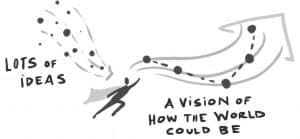
When someone asks us what a Catalyst is, the short answer is: it’s a person who takes in lots of information,
sees infinite possibilities,
and can’t stop themselves from moving into action.


Catalysts stand out from the crowd—not because of their scale of change, necessarily, or even their enjoyment of it, but because of their innate drive to create it.

Catalysts thrive on absorbing new information and constantly recognize problems to be solved and opportunities to be seized.

They quickly visualize solutions (though they don’t always clearly communicate them) and readily step into action, gathering even more data from failures and coming to even clearer solutions as they go (though those shifts aren’t always spelled out either).

This often happens without hesitation—sometimes even without conscious awareness.

Catalysts are often pioneers of incredible change, innovation, ideas, and creation. We work with Catalysts who launch non-profits, start companies, and strive to solve large scale problems.

However, you don’t have to work at large scale to be a Catalyst. We support Catalysts across all levels of many disciplines, from entry-level junior positions to the people leading organizations. We see Catalysts thriving as artistic solopreneurs and as leaders in government.

In other words, what Catalysts do (and are free to do) will vary as much as the Catalysts themselves. But the underlying drive is the same: At their core, Catalysts are simply motivated to solve problems.

Any problems.

They’re constantly spotting opportunities to make the world around them better (whether or not the world around them asks for it).


Graphic of A vision of how the world could be


They see problems, find solutions, right wrongs, and challenge the norm without a second thought.

They don’t need to be told to innovate. It is simply written into their DNA.

And it is precisely this natural inclination that creates problems for Catalysts and the people around them. When it looks and sometimes feels like we’re making magic, we don’t often think about the process behind it (or the consequences on the other side).

As Catalysts, we find hope in imagining a better tomorrow and assume that others do as well.

There’s a comfort most people find in keeping things the same, and Catalysts rarely hold that need sacred.

But the very bias for change that brings discomfort also carries with it remarkable potential that the organizations, teams, and peers who work in partnership with the Catalysts are able to benefit from.

The skills and energy that Catalysts bring to the table can move us all into a brighter future. 

This points us to another shared experience amongst Catalysts: All of that power that drives us toward our passions and projects forward just isn’t sustainable. Especially when it’s left to our subconscious processes.

As a result, we tend to burnout in regular, often predictable cycles. Run hard, hit resistance, feel stuck, burn out, repeat.


Illustration of a burnout cycle starting with a new exciting project and showing a descending line on a graph toward burnout


It’s helpful to know that you’re a Catalyst.

It’s life-changing to feel supported as one.


The Catalyst Supported

Before forming Catalyst Constellations, we both felt the need to bring groups of like-minded people together. But it wasn’t until we actually made that happen that we realized how much relief that would actually create.

You don’t know how much friction you deal with day to day until that friction is suddenly gone. 


A trio of young people jumping in the air with excitement


The clarity that self-identification as a Catalyst creates is often followed by a sense of relief to be amongst like-minded people. Not only do we begin to see ourselves differently, but we start to see others in a new light as well.

When Catalysts are supported within a community or as part of an intentional cohort like our Catalyzing Organizational Change course, the change that they’re working on comes into focus. The intensity they often show up with begins to redirect toward the change itself, focusing like a tractor beam and bringing more people along. The walls they run up against become saleable.

A supported Catalyst doesn’t have to wonder if they’re all alone in their vision anymore, or whether the magic is going to come through this time. They start to see themselves in their process and they see how others are affected by it.

Underneath the surface of all the skill-building and results-generating impact this creates, the biggest shift is a bi-directional empathy directed inward toward yourself and outward to others.


A New Sense of Self-Compassion

Nothing really compares to being in a room (or Zoom) full of Catalysts who’ve just realized they’re not alone.


Image of a Zoom meeting with 8 people in virtual boxes making hearts with their hands


When you look back on your life and it suddenly makes sense…When you look around at your current state and start to see how you got there…When you see the power in fellow Catalysts and then realize that same superpower lives in you too…

It’s like a weight taken off of your shoulders.

You’ve always seen the world differently than most, and now you have language to explain how and why.

You don’t just disrupt your surroundings—you see the solution before others may even notice the problem.

You don’t just push others outside of their comfort zone—your mind simply pieces together information in a way that makes action seem obvious to you that isn’t clear to them.

And you actually do know how to read the room—you feel the directional shifts in conversation and flow and just need to learn how to trust that.

Yes, you have room to grow.

But you aren’t broken.

The world needs Catalysts like you to shake things up, and you need self-compassion and rejuvenation if you’re going to make that happen.

The more our readers and community members understand themselves and each other, the more they’re able to practice self-compassion. They begin to self-heal as they reframe the circumstances of their lives and the challenges they used to blame themselves for.

When we see ourselves as Catalysts, we give ourselves space to be Catalysts. 


A New Level of Empathy

As we begin to learn about our strengths as Catalysts and how to use them with more intention, that sense of self-compassion grows into a deeper level of empathy for others as well.

We start to acknowledge where we’ve made things difficult for the people around us, without holding judgment or blame about the way they reacted to those challenges.

We might see that we had come to a clear vision but neglected to share or externalize it at all before heading toward it. No wonder they felt disrupted!

Or maybe we secured buy-in, but as more data came in, we iterated and moved the goalpost without checking in. No wonder they felt lost! 

Organizations need Catalysts to help them achieve, imagine, and move toward that brighter tomorrow, it’s true. But it will always be difficult for people to accept change—even though it is necessary to.


Chalk writing on pavement that says "Together we will change the world"


Once Catalysts self-identify and grow their strengths and intentionality, it’s easier for them to own those challenges that change presents and begin to advocate for themselves and others in clearer, more effective ways.

Catalysts who read the book or attend our courses find themselves stepping out with their catalytic tendencies forward:

  • “I noticed that our conversation shifted—can we talk about that? I know I can get kind of intense when dots start connecting.”
  • “Something you should know about me: I’m a Catalyst! That means I move kind of quickly, so if I lose you just let me know.”
  • “I think I took off on my own and messed that up. Can we walk back what happened and make a plan that works for both of us?”

The amazing thing is, we often have those emotional awareness skills on hand already!

We already know how to read a room. We just have to learn how to leverage that skill as part of our movement toward change.

We become more considerate of others when we know how our magic works. When we can spot the subconscious formulas and processes that make us tick—and then, by extension, how different those processes are for the people around us.

We haven’t arrived after reading one book or taking one class. Honestly, we’re not sure Catalysts in particular can ever arrive—how boring would that be?

But everyone at the table is more successful when we lead with our strengths, hold awareness for our weaknesses, and create space for the journey toward a shared future.


The Thriving Catalyst

Once we saw the need to support Catalysts in their changemaking efforts, we couldn’t unsee it. Our work grew from weekend retreats to educational material to an online community, and it continues to grow to this day.

Because it’s easy to see that Catalysts exist—it’s not easy to know what helps them thrive.

Or what they can do to move through a new change more effectively.

Or who they can connect with to help sustain that energy.

Essentially, we have directed all of that unique changemaking energy toward ourselves—toward the “problem” of being a Catalyst in the world and the solutions that make it feel powerful instead of draining.

No matter what iteration Catalyst Constellations makes, our mission will always be to enable Catalysts to move more quickly and satisfyingly towards the impact they aspire to create (and with less burnout!)

This is the work that we’re doing across all Catalyst Constellations platforms, but especially in  our courses. That’s where you’ll learn your strengths and blindspots as a Catalyst, assess your unique skills, recognize the value you bring to the table, and articulate that value in an effective way.

If you’re working on a specific change at the onset of one of our courses, you’ll learn how to formulate and share the vision, map out a plan of action, and pivot more effectively and intentionally.

If not, that’s okay—you’ll come to a deeper understanding of the way you think as a Catalyst and how you can leverage those skills the next time a change opportunity inevitably comes your way.

There is no secret Catalyst handshake that lets you in the club, either—though some might argue that a certain gleam in our eyes gives us away. No one’s waiting at the door to let you in or kick you out. Bottom line: If you’re shaping any kind of change in your world, you’ll likely find tools in our courses that will work for you.

If you’re standing at a point of transition or growth looking back at a trail of accomplishments and lessons learned—of criticism and miscommunication, big energy and big burnout, superpowers and super blindspots—wondering what to do next…

Welcome to our Constellation.


Image of a galaxy in space


We didn’t create Catalysts. We didn’t even name you. But we see you. We share your strengths and struggles. And we’re here for you as you step into the changemaking power that you’ve always had inside of you.

If you’d like to better understand who Catalysts are and how you can make a difference without running yourself or your career into the ground, start with Move Fast, Break Shit, Burn Out. When you’re ready to dive even deeper, the Catalyzing Organizational Change course is an 6-week hands-on experience where you can learn new tools, practice innate skills, articulate and take steps toward a vision, and connect with others as you grow and create meaningful change together. Welcome to the Galaxy. We hope you’ll stick around.


The 3 Most Common Mistakes of Catalytic Leaders

SHARE THIS POST:

After spending time focusing on the challenges shared by all Catalysts. In this post we are going to deep dive into the challenges of Catalysts who are trying to LEAD others through the 3 most common mistakes of Catalytic leaders.

When I met Anika she was in a state of paralysis because she had so many things happening at once. She was in negotiation to become a partner in her medical practice. She had previously run her own practice, but was eager to become part of an existing practice at this stage. She was trying to write a book summarizing research she had been conducting with her patients. She was looking at creating an app to better support her patients and others. And she was thinking about models of medicine and medical practices that she may be able to franchise. She was catalyzing change and everywhere she looked was opportunity.

In the course of our work she decided to take time to focus on the partnership in her practice first, or at least with most dedicated time. There were two existing partners and she was ready to jump in – she had a clear vision of how the practice could improve, could grow, better serve patients and become a model for medical practices around the country.

Yet she kept finding herself frustrated because her partners seemed to respond in baffling ways such as taking long periods of time to respond, looking at her blankly when she was sharing ideas, or even becoming defensive. Anika had worked with these colleagues for some time and had built trust, so she didn’t understand why it felt like they didn’t trust her in these discussions.

Looking back now Anika can see the places she made mistakes that many Catalytic Leaders make.

Models of Leadership

Let’s align around a typical model of leadership. To get things done well a leader can set a vision, orchestrate those that will be contributing or impacted and then implement. We can see the linearity and tactical nature of the model whereby one first creates a vision, then orchestrates the steps and others and then everyone implements each step.

A Typical Leadership Model

For Catalysts this model looks slightly different. Catalysts talk about two additional elements in their process: Storming and Iterating. And rather than tactical implementing, Catalysts talk more of manifesting change.

A Catalytic Model of Leadership

Storming is the period during which an idea is still forming and has not yet crystallized into a Vision. The name explains both the impairment of a lack of clarity – it is hard to see through a storm – and the tumultuous feelings that may accompany this period. This can be a time that feels like mania – both to the catalyst and those closest to them. It can be a wonderful feeling. And can be intensely uncomfortable. There is ambiguity during this period. Some catalysts are comfortable with ambiguity, but many are not. They simply come to understand it is part of the process.

Clarity may emerge over the course of one meeting – collecting data, collecting data, then ZING move to VISION. Or it may take more time. The more complex the problem, likely the more time and inputs it needs to solidify into a Vision.

A second unique element in the Catalytic Leadership model is the magical feeling of manifestation, as opposed to the tactical steps of implementation.

A final difference is that Catalytic Leaders iterate – pretty much from the beginning and every minute thereafter. This is hardly surprising given this is a telltale sign of a Catalyst – to take in new information and make changes based on it. To a Catalyst no endeavor is static… it must bend to the most recent information.

The Mistakes

Now that we have a model to work from, let’s discuss the most common mistakes.

#1 – Sharing Too Soon

The first common mistake that Catalytic Leaders make takes place during the STORM phase. Many Catalysts are external processors so a key way to get through the storm is to talk to people about what they are seeing. Plus they are OOZING with passion and excitement so they are excited to tell people. However, remember from challenges, Catalysts can be feared because they represent change and challenge to the status quo. Therefore talking to people about what you are brewing without a clear idea of the impact it may have on others, their workload, even their jobs, SCARES THEM!! Sharing too soon can result in fear, uncertainty and lack of trust.

Sharing too soon will send people running.

#2 – Jumping from Vision to Manifest…Leaving People Behind

By far the most common mistake Catalytic Leaders make is not taking the time to orchestrate those who will be responsible to drive things forward or will be impacted in some way. Catalysts jump from Vision to Manifestation – because Catalysts often just ‘know’ and move to action without really thinking about it. They often don’t think to create a vision or orchestrate people because they assume those around them saw everything they did. A common refrain of Catalysts: “We were all in the same meeting, I assumed we all heard the same thing, and therefore came to the same conclusion.” The next steps are usually so obvious, it often doesn’t occur to them to explain the steps, let alone a vision, to others.

Even if they do take the time to create and share a vision, being an orchestra conductor doesn’t happen in one share. Orchestrating a movement takes TIME. And impatient, quick moving Catalysts aren’t always great at taking that time. And orchestrating a movement requires REPEATING oneself. However, Catalysts aren’t great at repeating the same thing because they are on to the next thing.

Even when we get comfortable repeating a Vision over and over, the pace of orchestration can be frustrating and exhausting for Catalysts because catalysts naturally work at a superwoman pace. And they are replenished by MANIFESTING. Not by ORCHESTRATING.

Catalysts replenish by manifesting, not orchestrating – so they jump to action.

#3 – Catalytic Leaders Iterating too Quickly and Often

A final common mistake Catalytic Leaders run into is the speed at which they iterate. One of the defining attributes of Catalysts is they have a learning mindset and information is quickly turned into iterative steps for action. Plus a catalyst takes in information real-time (versus taking a long time to process information). Therefore once implementing or manifesting begins they optimize the path on the fly. Sometimes this is an optimization of the implementation process. Sometimes this is an iteration of the Vision itself. For those trying to be a part of a project like this it can feel like quick sand. They may have just met with the leader himself, but hears from a colleague that things are different. This can cause confusion, ambiguity or distrust. Even people very comfortable with change and ambiguity can struggle here, especially if the leader isn’t skilled at orchestrating.

Iteration that is too fast will feel like quick sand.

How Catalytic Leaders Grow

But not all hope is lost. There are examples of Catalytic Leaders who lead and disrupt beautifully! So let’s talk about what great Catalytic Leaders have learned over time and how they do things differently.

First, during STORMING, successful catalytic leaders lean into co-creation which has two key components:

  • They have a trusted group of people with whom they can share what they are learning, bounce ideas and co-create a vision.
  • As these leaders gain comfort in their skin they are very open about themselves as change agents and disruptors. And they move into roles that call for that. They are hired specifically for that talent. So they can share their process with people. And if they help teams or organizations move through change in ways that align, this becomes part of their brand.

Secondly, learning to slow down and bring people along on the journey is critical. This starts by explaining and modeling their vision, ideally with something tangible that people can interact with and look at later, for example a model or a picture.

Also, successful catalytic leaders learn to repeat the same information over and over. Communication frequency research in advertising has found you need to repeat something to people between 3-21 times to have it get through – the newer the concept, the more times needed. Because Catalysts are usually bringing something very NEW – perhaps an entirely new paradigm – the most successful Catalysts become skilled at sharing the same visuals and presentations over and over and over and over and over and over again… despite their desire to stick a pencil in their eye. They know the importance of this for the long game. This also keeps the Catalytic Leader accountable to not shifting that Vision too drastically.

Ultimately it will help to consider yourself not just a manifestor, but an orchestra conductor. And the orchestra is the way you manifest your bigger movements.

Finally, becoming much more deliberate once the orchestra is playing is important. Successful catalytic leaders learn to slow down optimization and allow the team to gain the skills to evaluate and tweak, only stepping-in to dictate when necessary. Exceptional catalytic leaders know they can’t change the world without bringing the team along … even if that means things won’t happen exactly as they’d like or at the pace they’d like.

Back to Anika

Fast forward to Anika today. She has come to understand her catalytic tendencies and the impact they can have on her partners. Not only has she learned to seed only a few ideas at a time (versus coming with a full page of new ideas each meeting), but she has come to learn that her own ideas actually get better when she slows down and takes the time to co-create with them. Now they have a shared vision and have regularly scheduled meetings to discuss orchestration and implementation toward that future – collaboratively.

The Challenges of Catalysts

SHARE THIS POST:

Self-doubt and questioning myself. If everyone here thinks things are OK, maybe it is me? I feel like I don’t fit in. Others may see me as ‘one thing is not like the other’. When I ask questions people look at me like I’m crazy. I see a bigger story. I am connecting pieces. I quickly create goals and want forward movement. But then I question myself when I look around me. And I question if I want to be a Catalyst. Or sometimes when I have a new idea and goal I think ‘Maybe this time it isn’t going to work?!’” – A Catalyst describing challenges they face

Being catalytic can feel amazing – you have a drive that gets you out of bed, see opportunity everywhere and manifest meaningful change. And yet…

There is PAIN that comes with being catalytic.

The slow pace of change. The frustration of explaining things over and over. Not sure which idea to act on right now. Feeling rejection or self-doubt. All of these are common challenges. In fact being a Catalyst comes with a long list of challenges. Research surfaced dozens of common challenges that group into 7 categories.

(Note: There are specific challenges for Catalysts that work within large organizations that are not represented here.)

1. Picking What to Do (aka Opportunity Paralysis)

Catalysts struggle to choose where to focus as they generally have multiple ideas simultaneously. The sheer volume of ideas can cause paralysis. This challenge manifests at a broad scope where sometimes Catalysts struggle to pick one idea to invest largely in. And in a smaller scope they can find it difficult to prioritize the tasks to tackle in the moment.

Key quote:

“It is a challenge to prioritize ideas and put it all into your lifetime. ‘What is #1?’ I don’t have unlimited resources. Time and resources are limited. [To stay on track] once I start a project I need a lot of organization and guidance.”

2. Challenges of Coming to Clarity

Once an idea has been picked (or has picked the Catalyst) the early stage of coming to clarity on the vision and exactly what should be done can be both frustrating and stimulating. This time is full of problem solving, initial steps and quick iteration that can push Catalysts to a frenzied manic state.

Key quote:

“The process of getting clear on my vision and goal can be a challenge. It is like the storming phase of team development. I have a general idea and I am puzzling. I’m all over the place. I have disconnected thoughts and inputs that are swimming. I am trying to put it all together. It is uncomfortable and fun and depleting and energizing. When I finally see my ideas that others were skeptical of manifested and proliferating it is almost outside of me, it is like Aaaaah!”

The sheer volume of ideas can cause paralysis.

3. Difficulty Bringing Others Along

Catalysts feel it takes a long time to manifest change with and through others, especially if the folks around them are not Catalysts. Commonly cited is the challenge of how slooooowly people around them move. Similarly, most Catalysts struggle with getting their ideas across. This is especially true if an idea is still formulating or if it is radically different than anything else people can relate it to. This makes it tough to get people on-board with a new idea – if it is difficult to get ideas across, getting people to move into action around the idea can be even more difficult. Or if they are willing to move because they trust you, they don’t understand what steps they should take because they don’t quite grasp the end goal – so it requires the Catalyst to slowly break things into tactical pieces, which can feel like torture. And when you are quite certain that you are “right” and you know where to go but others seem resistant, impatience and frustration can leak out.

Key quote:

“Sometimes it is so hard to get other people to see what you are seeing so clearly and easily. How do I get them to understand if they do these things this will be successful when it is so obvious to me? Then having patience for it. Do I really need to educate them? I assume they’ll get there and then they aren’t getting there. I get tired of waiting and I eventually tell them ‘do these three things’. You can’t always have people around you that are going to be really quick and get it all the time.”

4. Burning Out

Catalysts are often not great at building in activities or times of quiet that can recharge and sustain. This is especially true during the clarity phase described above. Related, Catalysts are often better at focusing outside of themselves rather than taking notice of their internal state. Therefore they can work themselves too hard without having noticed until they are close to collapse emotionally and or physically.

Key quote:

“I can be so externally focused that I lose sight of what I need. I will all of a sudden realize my bucket is empty and I need to refuel.”

When you know where to go but others seem resistant, impatience and frustration can leak out.

5. Impact on Relationships or Other Interests

The periods of mania can take a serious toll on relationships and outside interests. Catalysts talk of straining their intimate relationships as well as not taking the time to maintain friendships. Similarly Catalysts can become so consumed in their manifestations that they don’t take time for other things like hobbies. When a project ends (or worse, fails) this can be discombobulating because a Catalyst who has not created a schedule of engagements may be lost as to how to spend time.

Key quotes:

“It is an all-consuming drive. People use the word passion to describe it, but I wouldn’t necessarily use that word. There is an emotional draw to whatever you are working on. That is where everything I have done has either been something that drives me mad and I need to be solving it or it is such fun and a beautiful thing to explore. It is consuming, not passion. It feels great to harness that. It can also feel really frustrating because other parts of your life don’t get time and energy.”

6. Perception and the Fall Out from Perception

Additionally Catalysts are challenged by how they can be perceived and the emotional repercussions of these perceptions. Common negative perceptions include:

  • Being perceived as arrogant because they are “over confident” or they believe they are “right”.
  • Being feared because they often propose change that could disrupt the status quo or even disrupt someone’s project or role.
  • Being disliked because they are viewed as nay-sayers or constantly critical of how things are done.
  • Being misunderstood as having malicious intentions to undermine others versus the purpose led drive to optimize and change the world for the better.
  • Not having contributions perceived as valuable.

In response Catalysts report a profound sense of loneliness and isolation, some talking of loneliness from childhood. A second response is self-doubt. After hearing an idea is crazy or your way of being is wrong and disruptive over and over, some Catalysts begin to doubt a chosen path. Challenges to your way of thinking seem to pile up.

Key quote:

“Change is hard. For a lot of change to come from one place, one person – all uncertainty comes from THAT! My ideas make peers feel wrong. How do we deal with people we work with that may fear or distrust what is new and different? I threaten the status quo.”

Being a Catalyst can take a serious toll on relationships and outside interests.

7. The Challenge of Staying Interested

A final area of challenge is staying interested in a project once it has been manifested and has solid momentum. For many Catalysts their attention begins to be caught by other opportunities and ideas. Similarly executing on details or overseeing the execution of details can be a struggle akin to sticking a pencil in the eye.

Key quote:

“I struggle to stay on course. It is easy to get distracted with another idea. I need to funnel action into a course of action and stay the course. Ideally a cohesive and integrated approach.”

While there is much that is desirable about being a Catalyst, catalyticness can come at a cost that impacts relationships, as well as emotional and physical health. Throughout the research stories of how Catalysts overcome these challenges also emerged which will be shared in future posts.

Background on Catalyst Research

In November 2015, I looked at the similarities between my favorite clients. Stark similarities emerged. I didn’t have a word to describe them. Then in my very next coaching session with one of those clients he said “I realized I’m a Catalyst”. It was like lightning struck. Yes! That is what ties my favorite clients together. I had observational data from working with my clients, but I wanted to be more direct in my quest so I could better serve my ideal clients. I leaned into my background as an anthropologist and began to systematically interview people that self-identify as Catalysts. These posts are outputs from my research.

I’d love to hear your thoughts on and experience with Catalysts. If you self-identify as a Catalyst or change agent let me know what resonates!